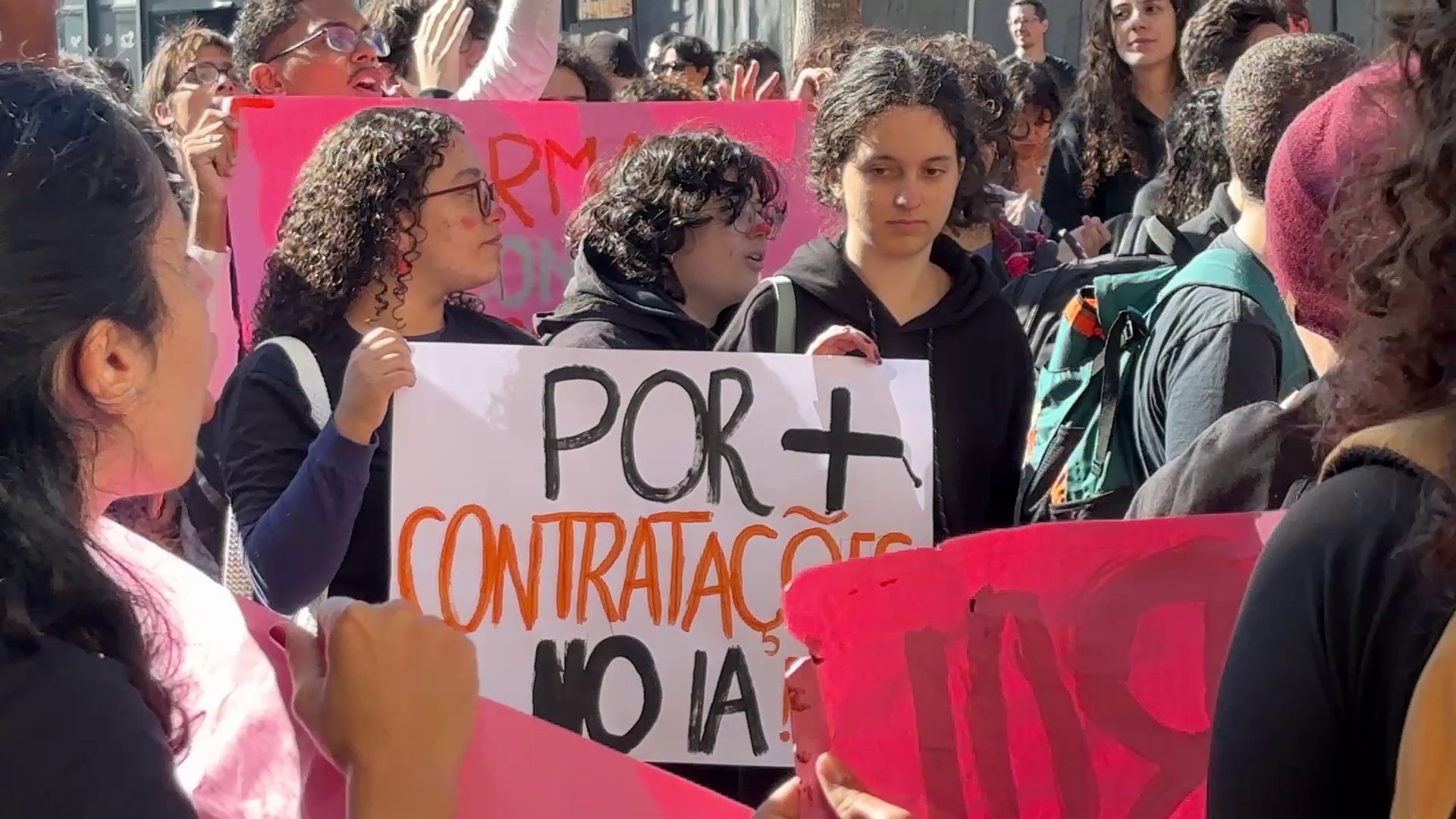
Dance and performing arts students denounce scrapping and lack of teachers at Unicamp
⚡ Quick Summary
Protesters demand hiring, salary adjustment and benefits Johnny Inselsperger/EPTV Students on dance and performing arts courses at the State University of Campinas (Unicamp) denounce a lack of teachers, precarious structure and insufficient budget.
Protesters demand hiring, salary adjustment and benefits
Johnny Inselsperger/EPTV
Students on dance and performing arts courses at the State University of Campinas (Unicamp) denounce a lack of teachers, precarious structure and insufficient budget.
According to students, classes take place in improvised spaces, while works intended for the courses have been stopped for decades. The rectory recognizes the demands and promises to start renovating the Institute of Arts' pavilions at the end of June (read more below).
✅ Click here to follow the g1 Campinas channel on WhatsApp
According to Heloisa Graciano, a fifth semester Dance student, the course, created 41 years ago, never had its own building. Currently, activities take place in "Paviartes", a warehouse that previously served as a warehouse for the Gleb Wataghin Institute of Physics (IFGW).
The student states that work on the building began in 2011, but was interrupted in 2015 after the bankruptcy of one of the companies responsible and the identification of structural problems.
"One of them was that there is a water table underneath the building, and the other is that there was a pillar that had to be six centimeters long, and they placed 11. Adaptations were made within this and today there is an analysis by engineers [saying] that the building will not fall", he explained.
Heloisa states that the problem related to water will be resolved in 2022. However, the theater's complementary works have not yet been completed, which prevents students from occupying the spaces.
The space was made up of two sheds, pavilions 1 and 2. In 2019, pavilion 2 was demolished with the promise that a new building would be built on the site.
"We need specific rooms with specific floors to avoid injuries. So, this is often not heard and we don't see the minimum things needed, the minimum details needed for a dance course, as well as acting courses too", he says.
Now on g1
Unfinished works
The situation also affects the performing arts course. The Laboratory Theatre, whose work began more than 25 years ago, remains unfinished.
A fifth semester student, who preferred not to be identified, reports that practical classes take place in improvised rooms and points out safety risks, including accidents and the presence of scorpions.
"When I say warehouse, it's not a sensationalist way of saying it; in fact, it's a warehouse in which we have classes, they are rooms inside a large warehouse with an extremely precarious structure, far from the ideal of what we should have", he comments.
The student also reports that classes are held in different spaces at the university, such as engineering buildings, the Basic Cycle and Casa do Lago. According to him, none of these locations meet the needs of the courses.
Work of the Theater at the Unicamp Arts Institute
Johnny Inselsperger/EPTV
Lack of support and budget
A recurring complaint in both courses is the lack of institutional support and resources for academic activities.
The dance student states that the course worked in two modalities: bachelor's degree and degree. According to her, the retirement of teachers without replacement of vacancies led to a reduction in the offer of subjects, including the Course Completion Work (TCC) of the degree.
"People in the fourth year do a bachelor's degree and in the fifth year they do a bachelor's degree, the TCC, right? And then there is an issue that we are also denouncing, which is, due to the lack of teachers, next year's curriculum, that is, those who enter from next year, no longer have the TCC and a degree", he says.
According to Heloisa, a document from the State Education Council points out that an analysis carried out in 2023 indicated the need for 16 teachers to serve the two courses simultaneously. Currently, there are 11 teachers, while students are demanding 18 vacancies.
"This comes from the college's own policy, which states that we do not automatically replace professors when they retire. What happens is this vacancy that was from dance goes to the general field. And it goes through a dispute between the units, to see which unit needs it more. If this vacancy goes back to the IA, it also happens that the IA has five courses that also really need vacancies, so there is an internal dispute within, to see where this vacancy goes", he explains.
The performing arts student states that students do not receive resources to finance research and artistic productions developed during graduation.
According to him, the discipline "Integrated Scenic Creation Processes" requires research and artistic productions, including shows developed by students throughout the course.
"And what happened? Unicamp does not provide any type of budget and says it does not have any type of budget for the performing arts course to be able to produce this research", he explains.
The student reports that, as the activity is mandatory for training, the students themselves need to raise resources to make the projects viable.
“This is done in different ways, but mainly through parties. Students throw parties, sell tickets, basically sell their workforce in order to graduate. Because if we don't have these parties, don't crowdfund, don't try to find ways to get money for our research processes, we won't be able to graduate", he says.
Aerial image of the Unicamp campus in Campinas
Reproduction/EPTV
Teacher overload
The student states that teachers accumulate subjects to keep the course running. He also highlights that the creation of a degree in performing arts has been claimed for more than seven years.
"So, it's a very simple calculation to do. If, every year, a teacher retires — and very soon, within a five-year forecast —, courses will start to run out. Both the dance, performing arts and music courses are, little by little, closing, and thus the Institute of Arts ceases to exist", he states.
According to the student, the university did not authorize new hires and avoided discussing the issue during strike negotiations. He also states that part of the hiring vacancies was allocated to the creation of the Artificial Intelligence course.
"That's why we joke and say that AI, Artificial Intelligence, has gone ahead of AI, the Institute of Arts", he says.
What do the institutions say?
The students claim that they participated in around six negotiation tables with the rectory and presented a letter with more than 60 demands.
According to them, the hiring of teachers did not advance in the discussions. The main promise was the creation of a commission to monitor courses considered to be in a critical situation.
In a statement, Unicamp informed that it recognizes the legitimacy of the demands and has made commitments to improve student retention and academic training.
Among the measures announced are:
Creation of working groups to discuss scholarships and investments of up to R$20 million in student housing on the Limeira campus;
Hiring seven psychologists and social workers to expand service to students;
Creation of committees to monitor accessibility, diversity and construction policies in progress.
The rectory representative, Roberto Donato, stated that the specific demands of the units will continue to be debated. In the case of the Institute of Arts (IA), he informed that the reconstruction of Paviartes is underway and that work should begin on June 20th.
Asked about the evaluation of the courses, the National Institute of Educational Studies and Research Anísio Teixeira (Inep) informed that the regulation of state universities is the responsibility of state governments, according to a rule confirmed by the Ministry of Education (MEC).
Inep also informed that the Preliminary Course Concept (CPC) does not apply to these degrees. From 2026, Unicamp's dance and theater degrees will be assessed by the National Student Performance Exam (Enade).
*Intern under the supervision of Gabriella Ramos.
Now on g1
VIDEOS: everything about Campinas and the region
See more news about the region on g1 Campinas
📰 Related Articles
Understand what it takes for Mato Grosso's first blessed to become a saint
G1 Globo
Driver falls ill and conductor takes over driving bus in Três Rios
G1 Globo
Influencer killed with a gunshot to the back of the head, accident with five dead and train to the coast of Espírito Santo; see the most read news of the week
G1 Globo
Justice gives 30 days to Union and city hall to guarantee health care in extractive reserves in AM
G1 Globo
PRF and PM seize 102 kg of cocaine base paste after chase in Dutra, in Taubaté
G1 Globo