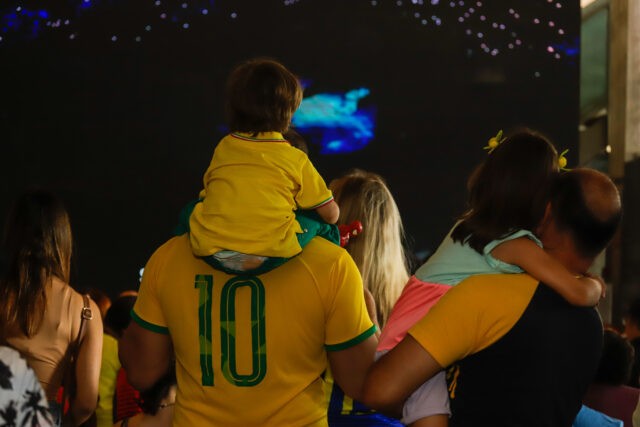
Streets decorated for the World Cup reinforce community bonds in Rio
⚡ Quick Summary
Experiencing the World Cup as something more than a football tournament between countries is an old tradition in Brazil.
Experiencing the World Cup as something more than a football tournament between countries is an old tradition in Brazil. Between family barbecues to watch the games and bets at work on the next score, another custom is regaining its place in the country: decorating the streets for the World Cup.
With green and yellow flags, paint cans, drawings of famous players and other national celebrities, Brazilians have seen more and more streets decorated for the tournament.
Related news:
Sesc units in SP have special programming for the World Cup.
Tourism project in Rio's favelas prepares special route for the World Cup.
Banks will have special opening hours on the day of Brazil's World Cup games.
The Brazilian team is the biggest champion of the competition with five titles, in 1958 (Sweden), 1962 (Chile), 1970 (Mexico), 1994 (United States) and 2002 (South Korea and Japan), but has not won a World Cup for 24 years.
The fast did not stop Brazilians from being excited. In Rio de Janeiro, residents from different parts of the city used art to express their support for Brazil in 2026.
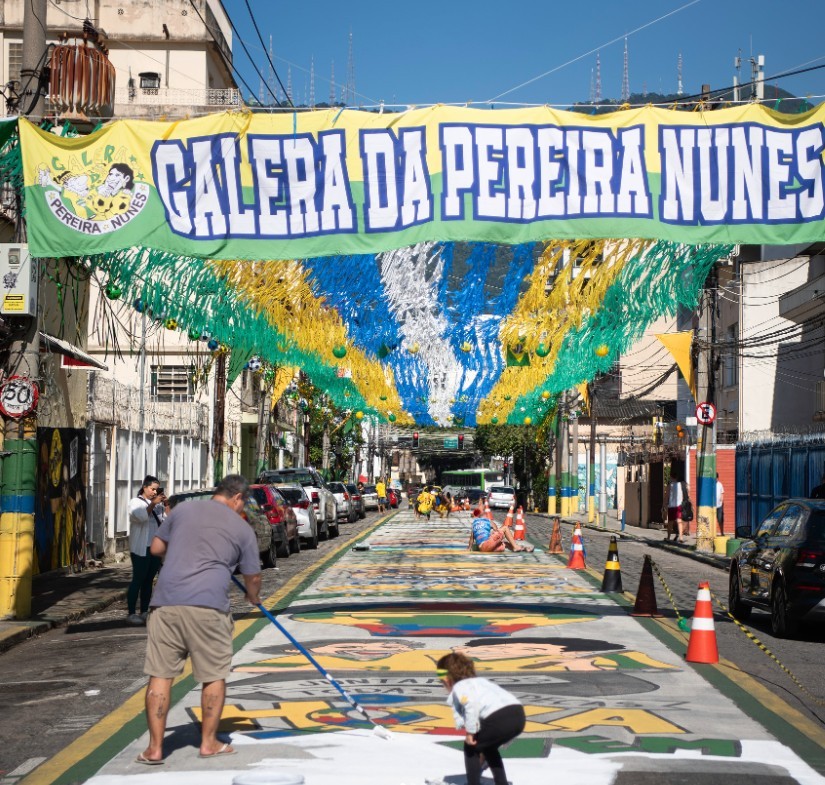
Rua Pereira Nunes, in Vila Isabel, north of the city, painted and decorated for the 2026 Football World Cup. Photo: Tânia Rêgo/Agência Brasil
Pinto Hill
In the Santo Cristo neighborhood, in the city center, the residents of Rua Capiberibe wanted to rescue the affectionate memories of those who grew up in the Morro do Pinto community, with a focus on the children who did not experience those moments. The vice-president of Centro Cultural Capiberibe 27, Isabel Boechat, coordinated the activities.
“The street gradually got into the atmosphere: residents helping, children painting, families accompanying, people arriving to help, collaborate in some way”, he says.
"Today my assessment of the action is that it was not an action done “for” the community, it was done with the community. At some point, it stopped being just a painting and became an encounter, coexistence, belonging."
Isabel says that the movement also attracted residents of Morro da Providência, Santo Cristo and other parts of the port region, who helped with the arrangement.
All material was paid for with the support of residents, friends, partners and people close to Centro Cultural Capiberibe 27, which donated much of the material. Traders in the area took care of the provisions and necessary materials, and the children received lunch, popsicles and snacks during the process.
Residents paint on Rua Capiberibe for the 2026 Football World Cup games. Photo: Thiago Nunes/Disclosure
For Isabel Boechat, more than technique and perfection, the main thing was to let the children be the protagonists of the party, rekindle this collective memory and bring the community together around the World Cup.
"They [the children] painted, imagined, put color on the street. And that has a great power, because maybe in the future they will remember: 'I painted my street for the World Cup'. That's what we wanted to deliver to them. And I think we achieved it", he concluded.
Turano Hill
The work they carried out also served as a stimulus for other parts of the city. University student Silvio Rosa, aged 21, says that the Morro do Pinto staircase was one of the inspirations for the decoration he helped create in the community where he lives in Rio Comprido, in the north zone.
A resident of Morro do Turano, he himself had never had the experience of painting the street for the World Cup, but he had the idea of organizing a graffiti day with the community's children in mind.
A few weeks later, I learned about a competition organized by the Favela Radical project, "Meu Beco na Copa", and decided to combine "useful with pleasant" by entering Alameda Manoel Costa.
"We didn't have much support from the people of Alameda and the community. In fact, there was a lot of distrust, people saying that we wouldn't be able to do it," said Silvio, who even asked neighbors for donations of materials but received no response. Residents paint on Morro do Turano for the 2026 Football World Cup games. Photo: Sílvio Rosa/Disclosure
“It was mostly the children, they joined in at all times, always asking us when the painting was going to be done and everything, always anxious. And they really helped a lot.”
The initiative was led by him, his girlfriend, Taíssa Brito, and the artist Anunki, with the participation of children from Morro do Turano. During the group's last weekend of work, when they finished the project, several parts of the community were already decorated.
"I see it as very positive, especially at this moment that we are living in the country, which is an election year. And rescuing all of this, being able to be part of this, rescuing these symbols for us, for the Brazilian people, is indeed very interesting. And living this together with the children is even more interesting", he added.
Residents paint on Rua Capiberibe for the 2026 Football World Cup games. Photo: Tatiana Chain/Disclosure
River in the Colors of Hexa
This year, Rio de Janeiro City Hall launched a notice to award decorated streets for the World Cup. The “Believe is an Art – O Rio nas Cores do Hexa” competition will reward first place with R$50,000, second with R$30,000 and third with R$20,000.
In the Vila Isabel neighborhood, in the north of Rio, the traditional Rua Pereira Nunes is ready to participate. It turns out that decorating the streets for the World Cup has been a custom for Galera da Pereira Nunes for over 40 years. It all started with the 1978 World Cup, and continues without interruption to this day.
Rodrigo Habbib, designer and Celso Mendes, organizer of the painting of Rua Pereira Nunes, in Vila Isabel, north of the city, painted and decorated for the 2026 Football World Cup. Photo: Tânia Rêgo/Agência Brasil
One of those mainly responsible for organizing the entire program, Celso Mendes, 48 years old, says that planning takes time and is a serious matter for the residents. Since 1994, he has led Galera da Pereira Nunes.
"We plan the next World Cup as soon as it ends, so it's four years of planning. And the relevance for our neighborhood is huge, they wait for us to plan this decoration, they keep demanding us. So, it's something very important, not only for our neighborhood, but for the country, right?", he said.
The street has already been featured in international newspapers, but, according to Celso Mendes, the party is not just about traditional decorations. Events with game broadcasts and live music are also being organized. Rua Pereira Nunes has already won four competitions and could reach the fifth championship, just like the Brazilian team.
The notice is available on the Municipal Department of Culture website and registration for the competition has been extended until June 20th.
Rua Pereira Nunes, in Vila Isabel, north of the city, painted and decorated for the 2026 Football World Cup. Photo: Tânia Rêgo/Agência Brasil
Rua Pereira Nunes, in Vila Isabel, north of the city, painted and decorated for the 2026 Football World Cup. Photo: Tânia Rêgo/Agência Brasil
Rua Pereira Nunes, in Vila Isabel, north of the city, painted and decorated for the 2026 Football World Cup. Photo: Tânia Rêgo/Agência Brasil
Rua Pereira Nunes, in Vila Isabel, north of the city, painted and decorated for the 2026 Football World Cup. Photo: Tânia Rêgo/Agência Brasil
Rodrigo Habbib, designer of the painting on Rua Pereira Nunes, in Vila Isabel, north of the city, painted and decorated for the 2026 Football World Cup. Photo: Tânia Rêgo/Agência Brasil
*Intern under the supervision of journalist Mariana Tokarnia.
🗞️ 2 sources covered this story
📰 Related Articles
Federal government allocates R$1 million for emergency actions in Jutaí after disaster
G1 Globo
A misleading version of history: Hobbes vs. Rousseau
Observador
My first World Cup: Babies hospitalized at Santa Casa de Sobral participate in a themed photo shoot
G1 Globo
Graça Machel portrayed as a political pioneer
Observador
Formula 1: Russell is the fastest in the last free practice in Barcelona
CNN Brasil