Streets painted for the World Cup return to color Rio and revive a tradition that marked generations; know where
⚡ Quick Summary
Streets decorated for the World Cup transform communities in Rio Anyone walking through the streets of Rio de Janeiro on the eve of the team's debut at the 2026 World Cup will encounter a scene that seemed to have remained in the past: little flags crossing blocks, streets and staircases painted green and yellow, groups of residents and children helping to transform the asphalt into a huge popular party.
Streets decorated for the World Cup transform communities in Rio
Anyone walking through the streets of Rio de Janeiro on the eve of the team's debut at the 2026 World Cup will encounter a scene that seemed to have remained in the past: little flags crossing blocks, streets and staircases painted green and yellow, groups of residents and children helping to transform the asphalt into a huge popular party.
After losing strength in the last editions of the World Cup, the tradition of decorated streets reappears in different regions of the capital and also in Niterói, driven by communities, historic neighborhoods and even competitions created to encourage this movement.
📱Download the g1 app to see news from RJ in real time and for free
From Via Ápia, in Rocinha, to Rua Jorge Rudge, in Vila Isabel; from Rua Pereira Nunes, in Tijuca, to Vidigal; from Escadaria do Fialho, in Glória, to Mirante do Santo Amaro, passing through Jardim América, Vicente de Carvalho, Botafogo and several neighborhoods in Niterói, residents once again invested time, paint and creativity to prepare their streets for the debut of the Brazilian team.
"A painted street represents belonging, identity and affective memory. It transforms a common space into a meeting place. There is a very strong cultural value in this because this tradition reflects the unique way in which Brazilians experience football", said Paula Carvalho, marketing manager at Sportingbet, sponsor of the party at Alzirão.
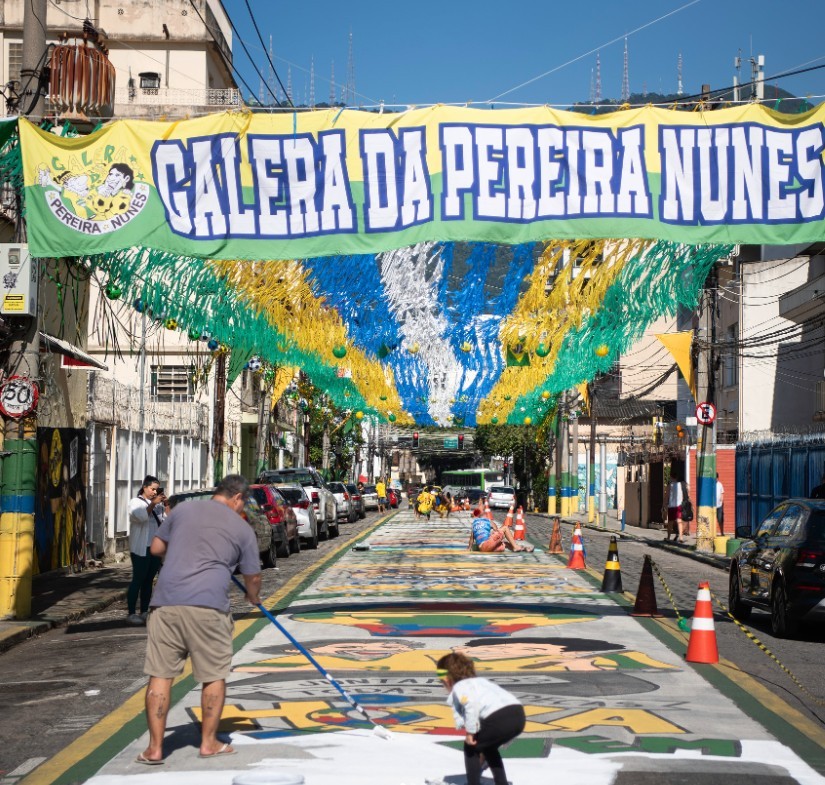
Rua Pereira Nunes, in Tijuca, ready for the World Cup.
Reproduction social networks
More than a decoration to accompany the games, the movement represents a revival of coexistence between neighbors and a tradition that has marked generations of Brazilians.
"In the end, it's not just about decoration, but it's about building something that people do together and show the world the passion and energy that are part of Brazilian culture," he added.
Rescue of tradition
For decades, the arrival of the World Cup also meant the beginning of a ritual in the neighborhoods of Rio de Janeiro. Days before the debut of the Brazilian team, residents gathered to raise money, buy paint, make flags and spend the night decorating entire streets.
The tradition, which especially marked the World Cups of the 1990s and 2000s, lost strength in recent editions of the tournament, but shows signs of revival in 2026.
Escadaria do Fialho, in Glória, and Mirante do Santo Amaro, in the South Zone, also got into the World Cup spirit
Reproduction social networks
For Humberto Maioli, director of Alzirão and one of the characters who followed this transformation over the years, the weakening of tradition has different explanations, such as generational changes, the pandemic and even the moment experienced by the Brazilian team.
Still, he believes that the fan's passion remains alive and can be awakened again.
"20, 30 years ago it was incredible magic. Everyone was waiting for the World Cup to arrive. Early mornings painting and decorating the street (...) In recent years people have cooled their relationship with the team, but that will change as soon as Brazil scores the first goal", bets the fan.
Traditional streets back
If the tradition of streets painted for the World Cup seems to gain new momentum in 2026, part of this strength comes precisely from places that helped build this culture over the last few decades.
In different neighborhoods of Rio, residents once again organized collective efforts, raised funds and dedicated days of work to transform their streets into party scenes.
Umbrellas in honor of Penedo on Jorge Rudge street
Reproduction/TV Globo
One of the most emblematic examples is Rua Jorge Rudge, in Vila Isabel. Known for decades of participation in the World Cups, the road once again brought together residents to install flags, paint the asphalt and set up a structure to watch the Brazilian team's games.
The street, which was awarded as one of the most beautiful during the 2002 World Cup, once again focuses on collective mobilization as its main differentiator. Professor Gabriela Rocha said that time was short to organize everything, but there was no lack of excitement and creativity.
"We had five days to do all this and we tried to do our best, our difference is always our ceiling, which we always bring something new, this time Jorge Rudge became Penedo, we put up the umbrellas and we unite the ideas of one and the other", he said.
Rua Capiberibe, in Santo Cristo, and Rua Taturana, in Vicente de Carvalho also won the Brazil colors.
Reproduction social networks
Gracyanne Barbosa will be crowned Queen of Alzirão before Brazil's World Cup debut
Staircase with Brazilian flag goes viral, attracts tourists and artists and changes the routine of village residents in the center of Rio
More than decoration, the objective is to keep alive a tradition that spans generations and transforms neighbors into partners in the same project: celebrating football in the streets.
Another address that maintains this identity is Rua Pereira Nunes, in Tijuca. This time, in addition to the paintings and flags, the residents decided to give even greater meaning to the collective work, using the decoration to promote a message of inclusion and belonging. The proposal is to show that the World Cup party can also be a space for welcoming and coexistence.
A symbol of this popular culture in Rio, Rua Alzira Brandão, the stage for the traditional Alzirão, also occupies a special place in the emotional memory of Rio fans.
For decades, the place brought together thousands of people to watch the national team's games and helped transform the street decoration into one of the World Cup's hallmarks in the city.
Residents of Rua Pereira Nunes, in Tijuca, and Rua Jorge Rudge, in Vila Isabel, promise to party at the Brazilian games.
Reproduction social networks
Communities making art
If in some neighborhoods the tradition has been maintained for decades, in several communities it has gained a new meaning: it has become a major open-air artistic intervention.
More than painting the asphalt green and yellow, residents began to produce true collective works of art, mixing football, graffiti, local identity and a sense of belonging.
In Rocinha and Vidigal residents did well for the World Cup.
Igor Albuquerque
The most emblematic example is Via Ápia, in Rocinha. The community's main road was completely taken over by paintings inspired by the World Cup in a joint effort that brought together artists and residents.
The result transformed the street into an open-air gallery and drew attention on social media for aerial images that show a long colorful corridor crossing the community.
"It's surreal to see Rocinha all painted like this. I'm a resident of Vidigal, a neighboring community to Rocinha, and I grew up with this tradition of painted streets. It looks beautiful", said the professional photographer.
"Favela is not violence, it is not war. Favela is color, it is brightness, it is tradition and it is light. And Via Ápia transmits this", commented Igor Germano, one of the organizers of the event on his social networks.
Video shows Via Ápia, in Rocinha, transformed by giant painting for the World Cup
Igor Albuquerque
A few kilometers away, Vidigal also paid tribute to the World Cup. As in Rocinha, the mobilization brings together residents to recover a tradition that marked generations and that, for some time, seemed to have disappeared.
In Mangueira, the Buraco Quente region received paintings that mix the colors of the World Cup with references to the traditional green and pink samba school, uniting two of the greatest local passions: football and carnival.
In Santo Amaro, in Catete, residents once again decorated the road with paintings and flags to welcome the Brazilian team's games. In Complexo do Alemão, streets and alleys also entered the World Cup atmosphere, showing that, even with its own characteristics in each territory, the tradition of painted streets continues to be a way of bringing neighbors together and transforming public space into a great collective celebration. The Santo Amaro favela, in Catete, and Fazendinha, in Complexo do Alemão, also got into the World Cup spirit.
Reproduction social networks
The movement, however, is not limited to the two communities. In Morro do Pinto, Rua Capiberibe once again received special paintwork for the World Cup.
In Glória, the Escadaria do Fialho gained new colors. In Jardim América, Rua Monsenhor Castelo Branco entered the World Cup atmosphere, as did Rua Taturana, in Vicente de Carvalho, Mirante do Santo Amaro and other points in the city.
In Niterói, the scenario repeats itself. Travessa São Feliciano, in Fonseca, Rua Ministro Sousa Costa, in Tenente Jardim, Comunidade Vila Ipiranga, Travessa Nossa Senhora Auxiliadora, in Santa Rosa, Estrada Alarico de Souza, in Atalaia, and Rua José Chianelli, in Piratininga, are among the places that decided to color their streets to host the World Cup.
The result is a kind of affective map of Brazilian football, built by the residents themselves and spread across different neighborhoods and communities in the Metropolitan Region.
Initial plugin text
Contests to encourage
The return of painted streets did not just happen spontaneously. This year, city halls and companies started investing in competitions and initiatives to encourage residents to decorate their neighborhoods and strengthen a tradition that has marked generations of Brazilians.
In the city of Rio, the City Hall launched a competition to reward the most beautiful streets decorated for the World Cup. The initiative will choose three winners, who will receive cash prizes, in addition to recognizing other streets that stand out for their creativity and mobilization of residents.
Copa Staircase goes viral on social networks and changes the routine of residents in the center of Rio
In Niterói, the city council created the "Minha Rua é Hexa" competition, which will select decorated streets to compete in a vote and will reward the best initiatives, encouraging popular participation and the organization of joint efforts between neighbors.
The private sector also joined this mobilization. The Via Ápia project, in Rocinha, for example, had the support of a company in the paint sector, as well as other initiatives that spread across the city and helped transform streets, staircases and communities into great settings for the World Cup.
The combination of public encouragement and the mobilization of residents, young and old, to rescue this Brazilian tradition brought back a collectively constructed cultural manifestation, capable of bringing together neighbors, strengthening the feeling of belonging and transforming the public space into a stage for coexistence and celebration.
Eduardo Jansen Street Staircase became an attraction after going viral on social media
Jessica Evelin Araújo /g1
🗞️ 1 sources covered this story

📰 Related Articles

"Nuclear is a question, but agreement is close"
ObservadorAnalysis: Iran's leaders bet on risks avoided by their predecessors
CNN Brasil
Boa Vista Junina competition brings together 10 gangs in search of victory; understand rules
G1 Globo
Is Bruna Biancardi a WAG? Understand what the term that went viral with the World Cup means
G1 Globo
World Cup alert: ICE uses football as 'bait' to hunt immigrants in the USA, says report
G1 Globo