


'Brick' cell phone, Windows XP and ICQ: what the technology was like when Brazil last won the World Cup
⚡ Quick Summary
Ronaldo during the 2002 World Cup Reproduction/TV Globo The Brazilian team faces Morocco this Saturday (13) and begins a new journey towards the hexa.
Ronaldo during the 2002 World Cup
Reproduction/TV Globo
The Brazilian team faces Morocco this Saturday (13) and begins a new journey towards the hexa. The trajectory of the 2026 World Cup can be closely monitored with social networks, real-time alerts and very high definition images.
It is a huge improvement compared to the year of Brazil's last world title. In 2002, the experience of watching the World Cup and interacting with other people online involved lower quality TV broadcasts and slower connections.
🗒️ Do you have any reporting suggestions? Send it to g1
At the time of penta, internet speed in Brazil used to be limited to around 56 kbps. Today, broadband in the country is hundreds of times faster, reaching 221 Mbps on average, according to data released in early May by consultancy Ookla.
The old dial-up internet used the telephone line and charged via electrical pulses. The price of the fare varied throughout the day and, therefore, many people chose to browse at night or on weekends, when the network was less busy.
Now on g1
And, instead of thin screens, computers used tube monitors (the same technology used in televisions at the time). Previously advanced devices, such as the iPod and PlayStation 2, already existed, but were not yet popular in Brazil. Remember what it was like to watch the 2002 World Cup.
No social media
The options for exchanging messages over the internet were much more restricted in 2002. There weren't even services that became extremely popular in Brazil and have now been discontinued, such as Orkut and Skype.
Without platforms like Instagram, WhatsApp or X, the solution was to look for services like ICQ, mIRC and online chats. It was also possible to interact through email chains.
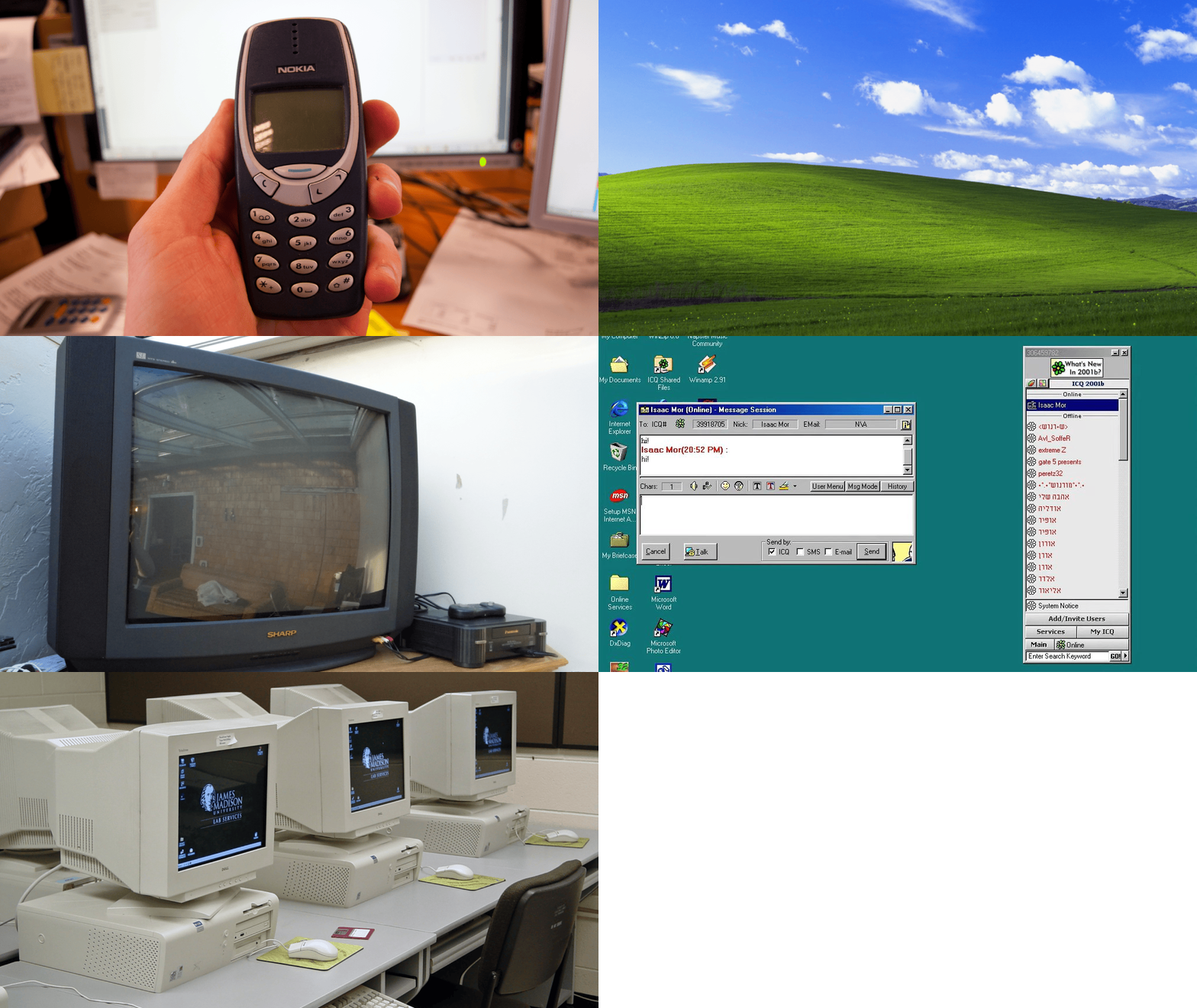
ICQ on Windows 98
Reproduction/Isaac Mor
ICQ, for example, had 100 million users in 2001. Each of them had an identification number and used the code to add friends.
Over the years, the service lost space to MSN Messenger, which had more features and was more accessible to users as it was installed on new Microsoft computers.
Wallpaper Windows
The 2022 World Cup was the first with Windows XP, launched a year earlier. The Microsoft system was notable for its default wallpaper, which shows a green lawn contrasting with the blue sky.
Computers with 512 MB of RAM and 30 GB of storage were considered advanced. Today, these specifications are easily surpassed by even the most basic smartphones.
'Bliss' wallpaper became famous in Windows XP
Reproduction
And even simple actions, like listening to music, were very different. The iTunes Store, Apple's store for downloading music, had not yet been launched, and the solution was to copy tracks from CDs or use services like Kazaa. To listen around, you had to use a discman. The iPod had already been launched before the penta, but it was very expensive.
Windows XP remained the world's most used computer system until 2012, when it was finally surpassed by Windows 7, according to data from market analysis firm Net Applications.
Today, Windows 11 is the Microsoft system with the most users. But the most used platform around the world is Android, present in most smartphones, as well as tablets, computers, smart watches and smart TVs.
'brick' cell phone
If today the best-known cell phones are the iPhone 17 and the Galaxy S26, the one that dominated in 2002 was the Nokia 3310. It earned the nickname "brick" due to its ability to continue working after numerous drops.
The device had a 1.5-inch monochrome screen, numeric keys that also served to write messages and support for 4 games. One of them was the classic "snake", the famous snake game. Nokia 3310
Kevin Steinhardt/Flickr
But while the old model had 1 kb of storage, the capacity of newer cell phones is hundreds of millions of times greater, considering the 256 GB space.
The Nokia 3310 sold 126 million units and became one of the most popular cell phones in history. The success was so great that, in 2017, HMD Global, which took control of the brand, relaunched the device.
A huge sales hit, the Motorola V3 would only be launched two years later. Until then, the most famous "flip" cell phone on the market was the StarTAC, which has had several generations since its launch in 1996.
Motorola StarTAC
Reproduction/Mobile Phone Museum
📰 Related Articles

SpaceX "is unique" but "many things have to go well"
Observador
29th edition of Parada Livre, intangible cultural heritage of Porto Alegre, takes place this Sunday
G1 Globo
Anthropic suspends access to more advanced AI models
Observador
Around 140 municipalities are at maximum fire danger
Observador