São João and the World Cup: streets of São Luís receive decoration that combines June tradition and hexa fans
⚡ Quick Summary
Streets of São Luís gain decoration that combines June tradition and hexa fans ⚽🎊 June weather and hexa fans: everything together and mixed.
Streets of São Luís gain decoration that combines June tradition and hexa fans
⚽🎊 June weather and hexa fans: everything together and mixed. In São Luís, the rhythm of São João combined with the passion for football to create a double dose of celebration.
📲 Click here and subscribe to the g1 Maranhão channel on WhatsApp
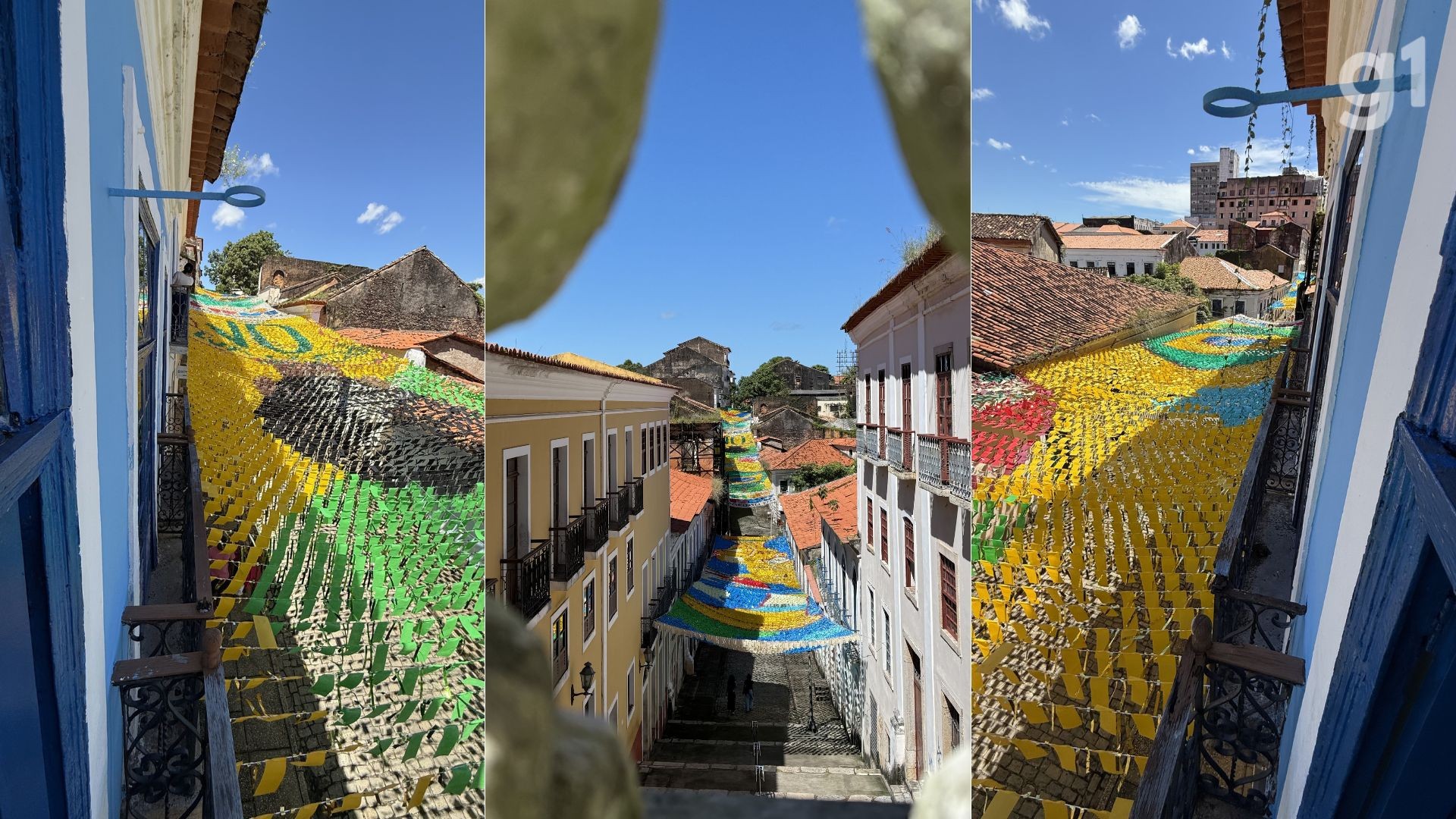
As the 2026 World Cup coincides with the June period, the traditional flags in the Historic Center have a new look, uniting two passions in a single setting. The decoration also extends to other streets in the capital, such as in the Tibirizinho neighborhood and on Rua 12, in the Cohab neighborhood (See the photo gallery at the end of the article).
Historic Center of São Luís decorated for the World Cup and São João
Photos: Hudson Souza
Although the green and yellow arraiá atmosphere is spread throughout almost the entire Historic Center, it is on the famous Rua do Giz, voted one of the most beautiful streets in Brazil by Casa Vogue magazine, that the decoration takes on a special charm.
Tradition completes almost 30 years at Cohab
On the other side of the city, in the Cohab neighborhood, the tradition of painting the asphalt, hanging flags and wearing the colors of Brazil is still more alive than ever on Rua 12.
The mobilization began almost 30 years ago, back in 1998. In 2026, the scenario is no different, with green and yellow already taking over the streets, the flags are stretched between the houses and the Brazilian team's shirts have become the residents' official uniform.
Tradition completes almost 30 years at Cohab
Disclosure/Personal Archive
The street decoration became a symbol of community unity. During the Seleção games, residents and visitors gather to watch the matches and cheer for Brazil together.
According to Paulo Lima, one of the organizers of the action, the preparation is done collectively and involves practically the entire neighborhood. "We have been organizing this organization since 1998. Residents contribute to a collection and we also hold raffles, bingos and other actions to raise funds for decoration", he explains.
Decoration involves all residents
Disclosure/Personal Archive
What started as a celebration of the World Cup ended up becoming a trademark of the community. For Paulo, the value of tradition goes far beyond football.
"This comes from our grandparents, passed on to our parents and is now with us. Decorating the street for the World Cup, for São João and even for Carnival shows that we continue to be the same community that got together to play volleyball in the street decades ago", he says.
Even those who have already left the neighborhood tend to participate in some way. Some return to help with painting, others contribute financially or follow the organization from a distance. “Everyone finds a way to be part of it,” he highlights.
The busy routine of residents and the costs of producing all the decorations are among the main challenges. The price of the paint and fabrics that make up the decoration are shared among the residents, which requires a lot of commitment from everyone. “Managing to reconcile all of this is complicated, but we make it happen”, highlights Paulo.
Residents of Tibirizinho combine Maranhão culture and passion for football
In the Tibirizinho neighborhood, residents came together to transform one of the region's hills into a huge green and yellow carpet, with elements that unite Maranhão culture and the passion for football, such as a Bumba Meu Boi in green, yellow and blue.
The initiative came from Jasf Andrade, resident and member of the "Sonhos de Quebrada" movement. With around 700 square meters of painting, the goal was bold: to create the largest street art in Maranhão.
Residents of Tibirizinho combine Maranhão culture and passion for football
Disclosure/Personal Archive
The painting covers the street from end to end, without leaving the asphalt visible. The result has attracted visitors from other neighborhoods, who come to the site to see the work and take photos. "It looks like a carpet, it looks like a square. The entire street is painted, and it's very big", the resident is proud. Behind the scenes, the biggest challenge was logistics. To complete the 700 m² project, Jasf says it was necessary to coordinate around 50 people working simultaneously.
According to Jasf, managing around 50 people painting simultaneously on the street requires care to avoid accidents with the paints or ruining the finished artwork. Furthermore, there is concern about the food of the team, which spends the day there.
The group's initial idea was to have just one street decorated as a representative of the neighborhood, but the success of the first slope led to other streets asking for painting. According to Jasf, the team has already completed work on a second main avenue and started painting a third.
"The objective is to embrace everyone, so that people feel represented when they pass by and it doesn't become something exclusive, closed in a ghetto. Tibirizinho will be almost entirely colorful", he states.
The project was also motivated by the recovery of a strong culture from the 1970s to the 1990s, which began to lose strength in the 2000s. Despite all the effort put into the decoration, the climate in relation to the performance of the Brazilian team is not the same as in other times.
Residents of Tibirizinho combine Maranhão culture and passion for football
Disclosure/Personal Archive
According to Jasf, the team's recent results have reduced anxiety about the games compared to the World Cups prior to the fifth championship, in 2002. Today, for the community, the event has gained a much more social meaning than a sporting one.
"This is the time to suspend a little the social or financial issues that each person may be going through, and play with the fun, with the momentary happiness that is the World Cup", he concludes.
See details of the decorations in the Historic Center, Tibirizinho and Cohab in the gallery below:
Historic Center, Cohab and Tibirizinho in settings that mix the atmosphere of São João and the 2026 World Cup
🗞️ 4 sources covered this story

World Cup: striker who has never played in the USA scores twice against Paraguay
CNN Brasil
Mosquito reveals that he received help from João Vicente to play Zeca Pagodinho
CNN BrasilAnitta talks about the emotion of opening the 2026 World Cup: “Indescribable”
CNN BrasilWorld Cup: USA x Paraguay has 7 players from the Brasileirão; check it out
CNN Brasil📰 Related Articles

Tren de Aragua: how Venezuelan faction in Trump's sights acts in Northern Brazil
G1 Globo
General manager of the Brazilian team receives honor in his hometown in RS
G1 Globo
João Fonseca at the Halle ATP: time and where to watch the doubles debut
CNN Brasil
With “Brazilian” goals, the United States beats Paraguay in their World Cup debut
CNN Brasil
Corpo de Brito, world champion with the Brazilian team in 1970, will be buried this Saturday
G1 Globo