They collect trash, fold clothes and learn from mistakes: the robots already working in Chinese homes
⚡ Quick Summary
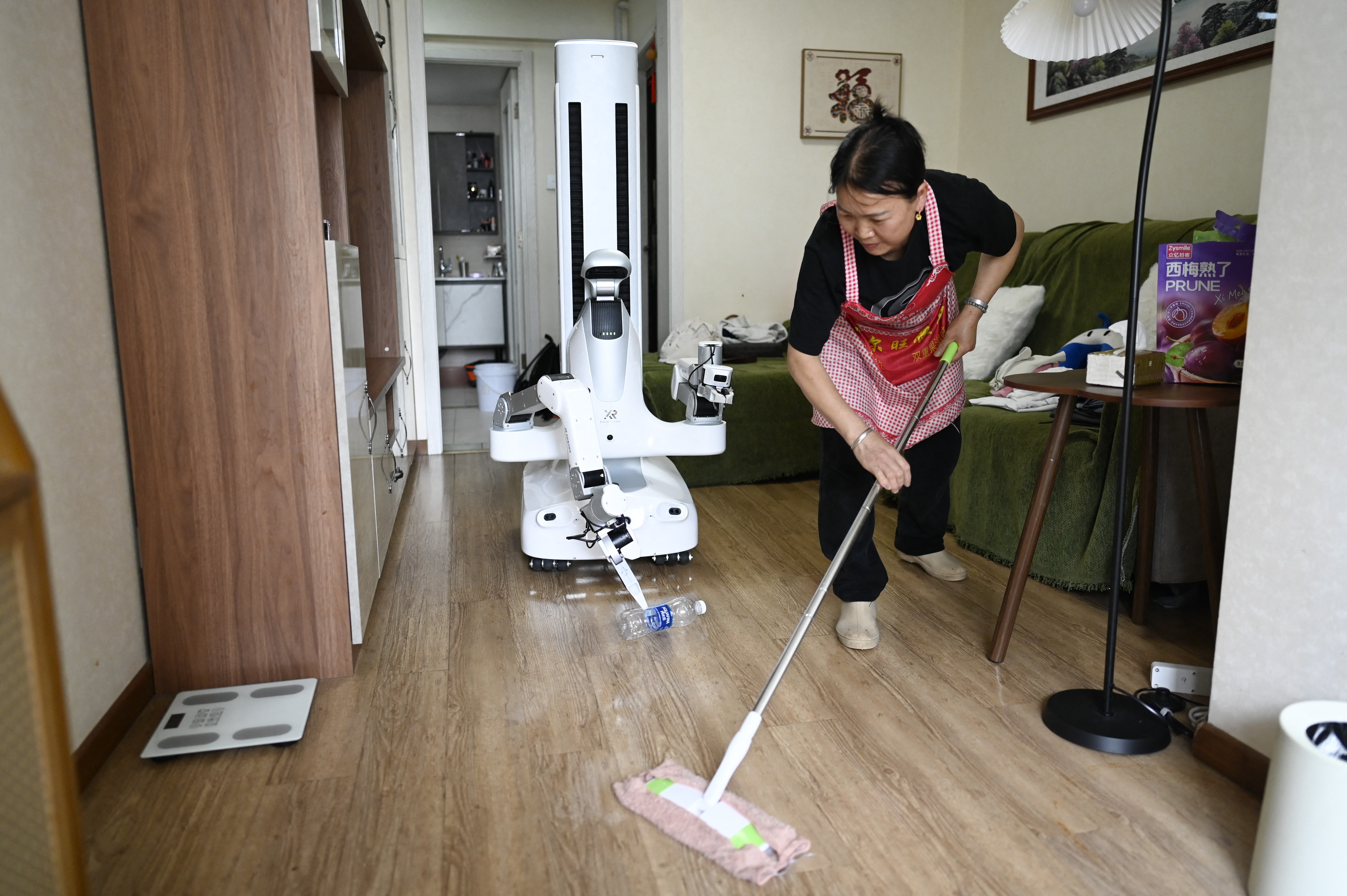
Photo taken on May 21, 2026, shows a maid working alongside an X Square robot at a client's home in Beijing WANG ZHAO/AFP For Lin Meiqiong, who cleans apartments in Beijing, things got easier when she gained an unexpected colleague: a robot on wheels powered by artificial intelligence.
Photo taken on May 21, 2026, shows a maid working alongside an X Square robot at a client's home in Beijing
WANG ZHAO/AFP
For Lin Meiqiong, who cleans apartments in Beijing, things got easier when she gained an unexpected colleague: a robot on wheels powered by artificial intelligence.
The 56-year-old woman and her white and silver companion, equipped with cameras and two mechanical claws, are part of a hybrid cleaning team - human and robotic - offered by the Chinese platform 58.com.
It's a small step towards a future in which robots take on more manual tasks. For now, however, these services are mainly for collecting data for companies and piquing customer curiosity.
"It's definitely different," Lin told AFP. "Before, I did everything myself. It reduced the load a little."
The service, the result of a partnership between 58.com and robotics company X Square, costs 149 yuan (R$114) for three hours and is available in Beijing and Shenzhen.
The Quanta X1 Pro robot enters the apartment with the help of an X Square engineer and uses cameras to identify areas that need cleaning.
While Lin takes care of the floor, he picks up trash and folds clothes.
The task takes several minutes, and the result is reminiscent of a child learning to fold pieces for the first time.
According to engineer Hu Bowen, future versions will respond to voice commands and be able to talk.
Better than a laboratory
Around 200 homes have signed up to the service since its launch in March.
Tan Pei, an advertising professional, hired the robot to clean his apartment because he wanted to "see what it could do."
"Although it's not perfect, some things surprised me," he said, citing the fact that he folded a pair of pants "really well."
Chinese robots impress in dance and martial arts performances, but their performance in real situations is still limited.
Photo taken on May 21, 2026, shows a maid working alongside an X Square robot at a client's home in Beijing
WANG ZHAO/AFP
For companies like X Square, launching an imperfect service helps collect data to develop so-called embedded artificial intelligence.
Unlike large language models trained on internet content, robots do not yet have comparable sets of real-world data.
"We still don't have an internet of robots," Christoforos Mavrogiannis, from the University of Michigan, explained to AFP.
"It's much more informative to put the robot to work and study what happens than to leave it in the laboratory forever."
Hu said he sends his robots to perform in "completely unfamiliar environments."
"This is very challenging, but this data helps a lot in developing the robot."
Photo taken on May 21, 2026, shows an X Square robot folding clothes at a customer's home in Beijing
WANG ZHAO/AFP
With increasing investment in embedded AI, China is also testing robots that guide traffic in cities like Hangzhou.
The company GigaAI plans to send 100 robots to homes in Wuhan this year for free cleaning tests.
Investors allocated more than 57 billion yuan (R$43.7 billion) to the Chinese embedded AI industry this year, more than in the whole of last year, according to the ITjuzi database.
Very early stage
There are still many obstacles to the popularization of these devices.
As the Quanta X1 Pro showed when folding clothes, robots still can't match human skill.
"Many companies are working on developing autonomous robotic hands, but they're not there yet," Mavrogiannis said.
Additionally, there are regulatory issues to be resolved.
Privacy will be a central theme, as robots will have access to a lot of personal information.
"We don't know where the data will go, where it will be stored (... ) nor who will have access to this information", observes Valeria Alessandra Macalupu Chira, from the Queensland University of Technology.
The safety of customers and their homes also remains an issue.
"I think we are still at a very early stage," said Yang Jianfei, from Singapore's Nanyang Technological University.
Now on g1
According to him, robots still require human supervision for emergency braking functions and there are no industry-wide recognized safety standards.
Experts agree that large-scale acceptance of these robots is still a long way off.
Asked about the possibility of robots revolutionizing her profession, Lin doesn't seem worried.
"Compared to people, it's obvious he's not at the same level," he said. "After all, it is a robot."
Photo, taken on May 21, 2026, shows an X Square robot organizing items on a shelf in a customer's home in Beijing.
WANG ZHAO/AFP
READ ALSO: First leather bag made from T-Rex cells goes up for auction
📰 Related Articles

Albania: thousands demonstrate on the 12th day of protests against Trump-linked resort
Euronews PT
Out of tune military personnel and the Alcochete orchestra man
Observador
Kid Abelha's return to the stage will have a 'killer setlist' and songs never played in shows, says Paula Toller
G1 Globo
What is known about the possible peace agreement between the US and Iran
CNN Brasil
What was Porto Alegre like 24 years ago, when Brazil won the penta?
G1 Globo