Government and CNJ launch guide to strengthen people search policy
⚡ Quick Summary
The Ministry of Justice and Public Security (MJSP) launched, this Thursday (11), three publications for guidance, training of public agents and reference for the formulation, implementation and improvement of managers' actions aimed at locating missing people throughout the country.
The Ministry of Justice and Public Security (MJSP) launched, this Thursday (11), three publications for guidance, training of public agents and reference for the formulation, implementation and improvement of managers' actions aimed at locating missing people throughout the country.
The new documents are:
Related news:
Registry of missing people renews hope, families say.
Rescue teams pull four people from flooded cave in Laos.
Flood leaves 44 people missing in the United States.
· the booklet “Action of the Military Police and Municipal Guards in the Search for Missing Persons”;
· the Guidance Guide for State Central Authorities; and
· Diagnosis of the Management of Deceased Persons with Unknown Identity in Brazil.
The launches are part of the National Policy for the Search for Missing Persons and took place during the Interinstitutional Seminar on the National Policy for Missing Persons, held in Brasília.
The director of the Unified Public Security System of the Ministry of Justice and Public Security (MJSP), João Alberto Nogueira Júnior, emphasized that the disappearance of a citizen requires a response that guides and empowers public authorities, in addition to serving as a reference for formulating and improving actions.
“No single body has all the tools necessary to face such a complex and multifaceted phenomenon,” he explained.
The director of the Unified Public Security System of the Ministry of Justice and Public Security (MJSP), also recalled the creation of the National Registry of Missing Persons, which unifies data from state civil police to speed up searches across the country.
"The disappearance of a person represents one of the most distressing situations that a family can face. It is an occurrence that transcends the sphere of public security, profoundly impacting human dignity, fundamental rights and the family and community structure itself," he stated.
Elisa Calcaterra, Deputy Resident Representative of the United Nations Development Program (UNDP) in Brazil stated that the launch of the materials represents an important step to strengthen institutional action and expand the guarantee of the rights of affected families. “We have to put the most vulnerable people at the forefront, the people who are facing the biggest challenges, and support these people together.”
The pain of family members
During the opening of the seminar at the headquarters of the Ministry of Justice, the representative of the National Movement of Relatives of Missing Persons and founder of the Associação Mães da Sé, Ivanise Espiridião, spoke about the pain of the families involved in this issue.
"Disappearance is one of the most painful experiences a family can face. There is no goodbye, there is no explanation, there is no closure. There are just questions that accompany mothers, fathers, children, siblings and friends every day. Each missing person has a name, a story, a family that waits. And each family deserves an answer", he charged.
Ivanise started after the disappearance of her daughter, Fabiana Esperidião, in December 1995, in the city of São Paulo. For her, the lack of answers is one of the cruelest realities imposed on a human being and, therefore, for around 30 years, the leader of the civil movement has been fighting for improvements in the system for identifying and locating missing people.
"When we talk about disappearances, we don't just talk about numbers or statistics. We talk about lives interrupted, stories without answers and families who live with uncertainty every day."
Judiciary
On that occasion, the National Council of Justice (CNJ) also published the Manual for implementing the CNJ Resolution (nº 634/2025).
The document establishes humanized guidelines and protocols for the assistance and action of the Judiciary in cases of missing people. The objective is to guide judges in legal actions, for example, declaring absence, presumed death and other procedures.
By prioritizing the reception of families, the project manager of the General Secretariat of the CNJ and manager of the Plural Justice Program, Natália Dino, revealed that the CNJ's expectation is to promote qualified listening by Brazilian judges and the recognition of family members as victims of the process.
"In the end, what we hope for is a commitment so that the wait is not endless, so that the search is not lonely, so that the pain is not made invisible. This is our balancing hope that we assume today with the many Marias and Clarices of Brazil.", he said in allusion to the song O Bêbado e o Equilibrista, by Aldir Blanc and João Bosco, performed by Elis Regina.
The excerpt makes reference to Maria Aparecida Fiel, eldest daughter of metalworker Manuel Fiel Filho, and Clarice Herzog, wife of journalist Vladimir Herzog, both killed on DOI-CODI premises, in opposition to the military dictatorship.
🗞️ 3 sources covered this story


📰 Related Articles

SpaceX confirms record listing on stock exchange
Observador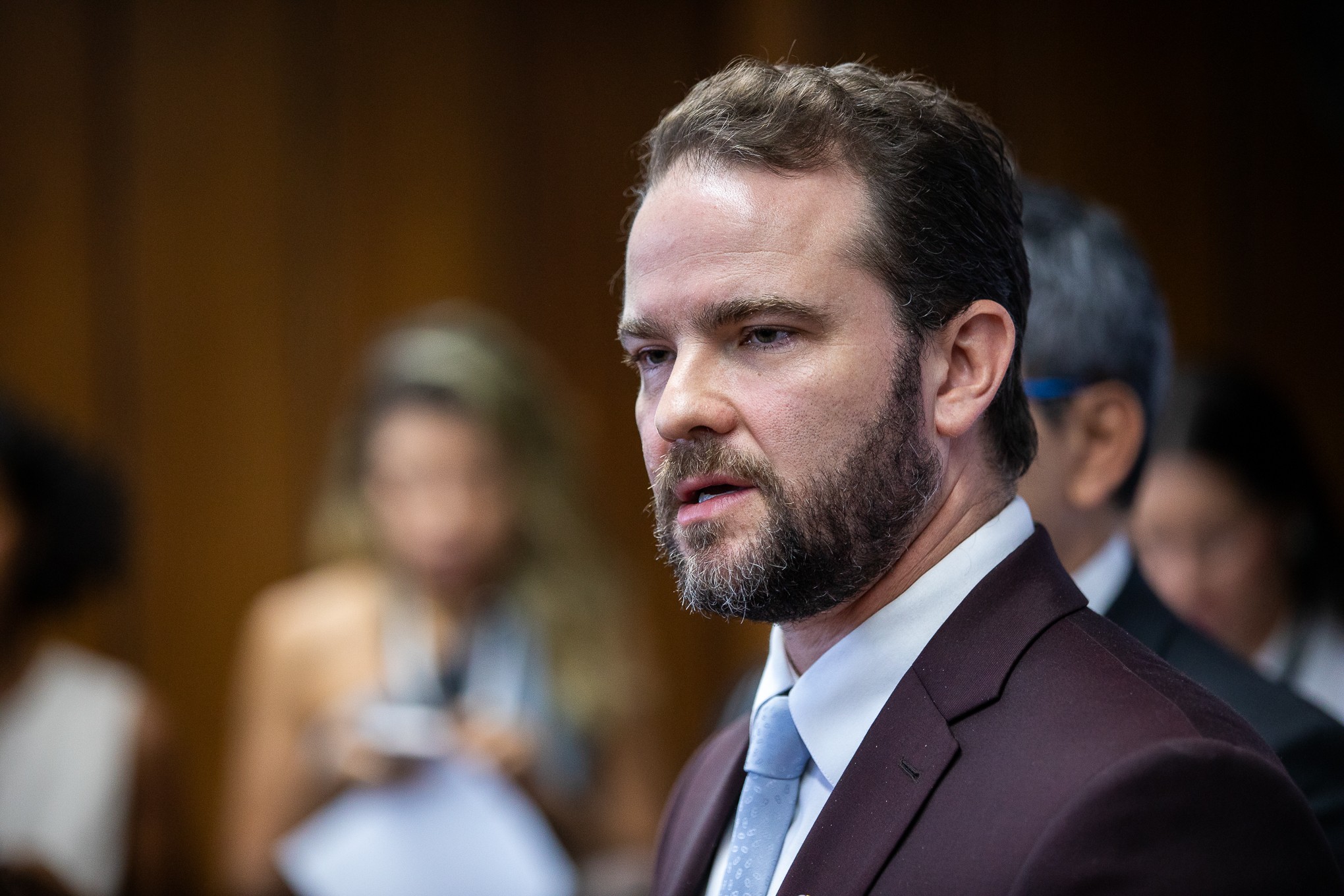
Treasury redoes calculations and now says that the impact of Congress's bomb agenda exceeds R$ 111 billion per year
G1 Globo
Cat is rescued more than 20 meters high in a tree during rain and wind in Bom Repouso, MG
G1 Globo
Watch Jornal Vanguarda live on g1
G1 Globo
'Audio of love': see new reactions from babies when hearing their parents' voices at school and understand the trend
G1 Globo