


Why can't children climb trees in SP parks? Villa-Lobos case reignites debate about rules that prohibit the practice
⚡ Quick Summary
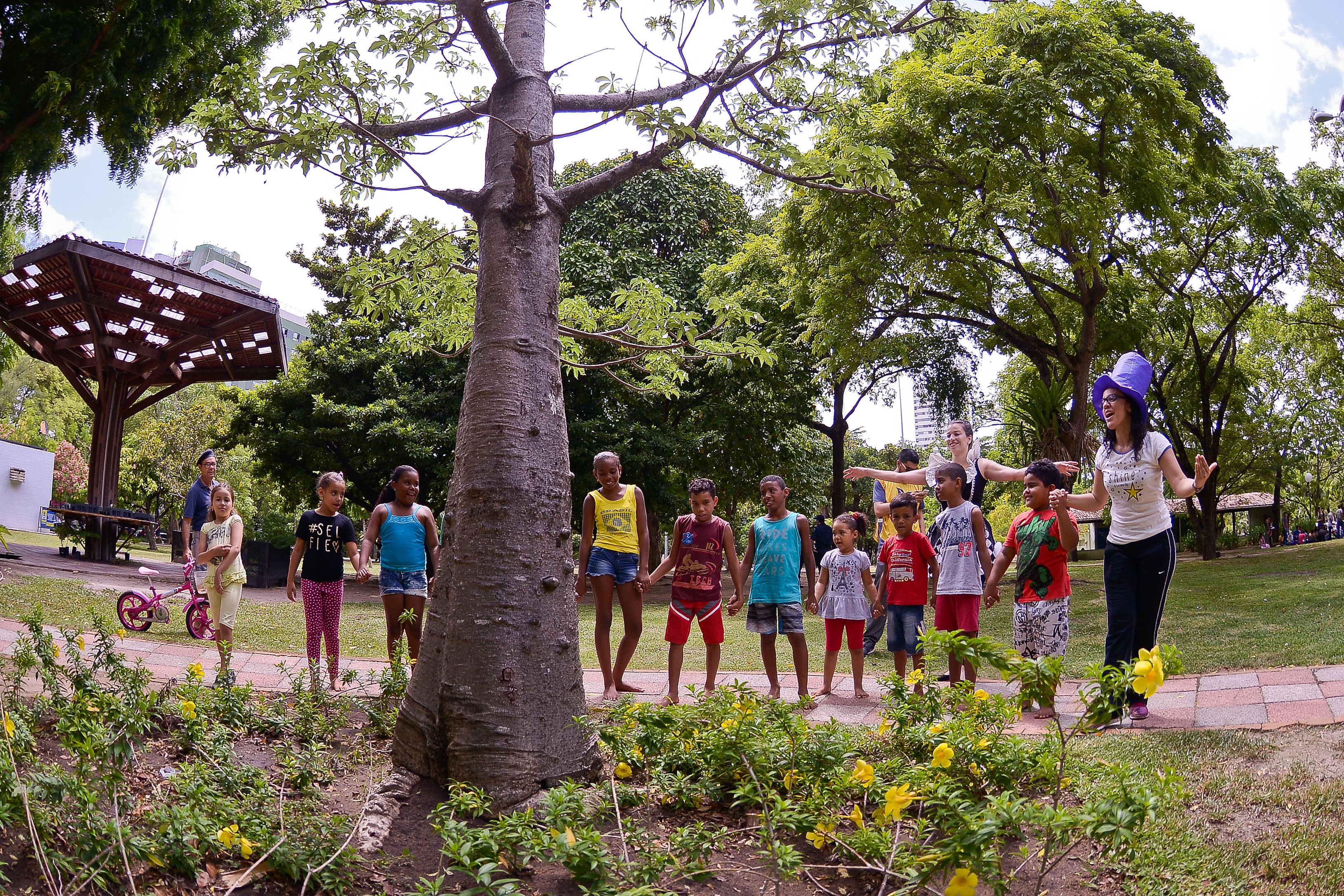
Trails to discover the park's trees and endangered species are also part of the itinerary Daniel Tavares/PCR/Disclosure A 7-year-old boy ran across the grass of Parque Villa-Lobos, in the West Zone of São Paulo, and climbed a small tree close to his parents.
Trails to discover the park's trees and endangered species are also part of the itinerary
Daniel Tavares/PCR/Disclosure
A 7-year-old boy ran across the grass of Parque Villa-Lobos, in the West Zone of São Paulo, and climbed a small tree close to his parents. His father, botanist and landscaper Ricardo Cardim, was sitting on the lawn when he heard the sound of a motorbike approaching.
According to him, a park security guard stopped next to the family and informed them that a child had been seen climbing the tree and that this was not permitted under the rules of the place. The case occurred last Friday (5).
Cardim claims that his son was scared and embarrassed by the approach. Afterwards, the botanist recorded a video reporting the episode and questioning the ban. Published on social media, the report went viral and reignited an old debate in São Paulo: to what extent can rules created to protect trees and users limit children's free play and contact with nature?
The discussion gained strength because the guidance given by the security guard was not an isolated decision. São Paulo municipal and state park regulations prohibit visitors from climbing trees. The restriction has existed for at least two decades and is usually justified for reasons of safety and environmental preservation (read more below).
Beautiful stories mark 70 years of Ibirapuera Park
In Parque Villa-Lobos, managed by the concessionaire Reserva Paulista since 2022, the regulations expressly prohibit climbing, writing or tying objects to trees.
When contacted by g1, the concessionaire stated that it regrets the discomfort caused to the family and said that the guidance given by the security agent followed the current rules for using the park.
According to the company, the restriction is part of the Operationalization and Use Regulations drawn up in 2019, before the concession process, and aims to prevent accidents and contribute to the preservation of plant species existing on site.
The concessionaire also stated that it is open to listening to society to discuss "new alternatives for interacting with nature for children", as long as safety criteria are respected (read more below).
In a statement, the Municipal Secretariat for Green and Environment (SVMA) informed that it "values the use of parks by children and that the rules are not intended to restrict contact with nature, but to protect trees (read more below).
Experts interviewed by g1 state, however, that experiences such as climbing trees help children's motor, emotional and cognitive development and question what they consider to be an excess of control over childhood in public spaces.
In São Paulo, if a child cannot climb a tree in a park, where will they climb? At school? At home? On the street? Parks need to be aware of their responsibility to provide this type of experience
According to her, parks play an important role in a city like São Paulo, where opportunities for spontaneous contact with nature have become increasingly rare.
"If a child can't climb a tree in a park, they might not climb anywhere."
Botanist Ricardo Cardim recorded a video reporting the episode and questioning the prohibition of a child climbing a tree.
Reproduction
The expert also states that episodes like the one that occurred in Villa-Lobos reflect a broader trend observed in large cities: the reduction of children's autonomy and opportunities to play outdoors.
The book "Parques Naturalizados", organized by the researcher herself and published in 2022, points out that the so-called "range of action" of children has been decreasing over the generations, which reduces experiences of exploration, discovery and contact with nature.
The concept deals with the distance that children can travel alone around the neighborhood to go to school, visit friends or use public facilities. "A park needs to ask itself what it is doing to provide experiences that children no longer find so easily on a daily basis. Climbing trees, running, building a cabin were very spontaneous activities 30 or 40 years ago and today they are almost extinct", says Isabel.
"Green areas play an important role in tackling this scenario we call nature deficit or children's enclosure."
Development
For Isabel Barros, who coordinates projects related to nature-based education and health, climbing trees stimulates motor skills, creativity, self-confidence and risk perception.
"A child who grows up without these experiences grows up with a more impoverished repertoire of risk management. And this has an impact on their entire life", he states.
According to her, dangerous situations are those that can lead to serious consequences, such as letting a child who doesn't know how to swim play alone near a river or swimming pool. The risk, he says, can be managed by both adults and children themselves.
"When children have the opportunity to grow up exposed to this type of risk, they calibrate how far they can go, what they can do and what they cannot do. If they grow up without these experiences, they develop a more impoverished repertoire of risk management", he states.
"The risks in life begin by climbing a tree, going down a hill, running. This is how children and adolescents become more prepared to deal with challenges in their daily lives."
Public enjoying Villa-Lobos Park on a hot Saturday
ALOISIO MAURICIO/FOTOARENA/ESTADÃO CONTÚDO
One of the alternatives, according to the specialist, would be to identify suitable trees for the activity and mark them for use by children, with guidance from families.
"There are trees with low, strong branches and grassy areas underneath. It is possible to think about management solutions instead of simply prohibiting them."
Educator and anthropologist Adriana Friedmann, author of several books on childhood and child development, believes that the episode reveals a broader process of restricting children's autonomy.
"There is a movement to sanitize children and want to control children's every movement," he says. "Adults who create these rules often forget their own childhood and how important experiences like climbing trees were to their development."
For her, free contact with nature is fundamental for child development and goes far beyond recreation.
"Children develop through experience. They need to experiment, explore, discover the world around them. Playing is one of the most important languages of childhood. "We want to protect children, but we often end up blocking experiences that are fundamental to their development," he says.
According to Adriana, although there is a legitimate concern about safety, adults often end up interfering excessively in children's autonomy processes.
"What is being very harmful today is leaving children alone with screens, without socialization and without the opportunity to experience contact with their bodies in the city, in nature and with other children."
Preserve nature
Ricardo Cardim himself says he was surprised by the approach. Botanist, landscaper and creator of the Trees of São Paulo project, aimed at scientific dissemination about urban afforestation, Cardim usually produces content about the relationship between nature and cities on social media.
"My son was embarrassed. I saw that he was scared. It's a difficult situation for a child to understand," he told g1.
According to the landscaper, who is a plant anatomist, the tree where the son was was low and posed less risk than some toys available in the park itself.
"Then I took my son to the playground and saw artificial toys taller than the tree he was in. It doesn't make sense. "
Cardim also questions the environmental preservation argument used to justify the ban.
This argument that is based on preserving trees, as a botanist and great defender of nature that I am, a public figure in this sense, for me is a total mistake. Preserving nature is teaching children to love nature
He states that, after the repercussion of the video, he was contacted by the park administration. During the conversation, he suggested that some trees be identified as suitable for children's climbing, allowing children to have this type of experience in conditions considered safe.
Villa-Lobos Park, in the West Zone of SP.
Rodrigo Rodrigues/g1
The proposal is similar to that defended by experts interviewed by the report. For them, the discussion goes beyond a specific park rule.
The debate involves the space reserved for children in a metropolis where playing in the street, exploring empty lots, running without constant supervision or climbing trees have become increasingly rare experiences.
Rule has existed for over 20 years
The ban on climbing trees is not exclusive to Villa-Lobos. Municipal regulations consulted by g1 show that the fence already appeared in parks in the capital at least in 2003. In the regulations for the City of Toronto Park, in the North Zone, it was already prohibited to "climb or damage trees".
More recent standards maintain the same guidance. In a regulation published by the City Hall in 2025 for the Feitiço da Vila Linear Park, in the South Zone, it is also prohibited to "climb, damage, attach ornaments, nets or other equipment to trees".
The Department of Environment, Infrastructure and Logistics (Semil), responsible for formulating state policies related to parks, did not respond until the last update of this report.
What the concessionaire that manages Villa-Lobos says
Read the note in full:
"The concessionaire informs that, as soon as it became aware of the situation, it contacted the family involved and regrets the discomfort caused.
We reiterate that the guidance provided by the security agent followed the current rules for use of the park, which are published on the website https://parquevillalobos.com.br/normas-e-acessabilidade/. The restriction on climbing trees is provided for in the Operationalization and Use Regulations, drawn up in 2019, before the concession process, and aims to prevent accidents and contribute to the preservation of plant species existing on the site.
We are open to listening to society to build new alternatives for interacting with nature for children, always focusing on offering a safe, welcoming and constantly evolving place, expanding opportunities for visitors to enjoy contact with the environment in a responsible and safe way."
What the SVMA says
Read the note in full:
"The Municipal Green and Environment Secretariat (SVMA) informs that municipal parks have usage regulations, approved by management councils, which prohibit practices that could cause damage to vegetation or compromise the safety of visitors, such as climbing, attaching ornaments, nets or equipment to trees and sculptures. The measure aims to preserve vegetation and reduce the risk of accidents, in accordance with the environmental conservation and safety objectives of these spaces.
The Ministry highlights that it values the use of parks by children and that the rules are not intended to restrict contact with nature, but to protect the trees. To reconcile interaction and preservation, SVMA implemented naturalized playgrounds, with toys produced from tree management waste, in addition to maintaining dialogue with institutions linked to childhood issues, in order to improve environmental policies aimed at children.
SVMA also emphasizes that, when situations are identified that do not comply with the standards and cause actual damage to environmental heritage, the measure adopted is guidance and verbal warning, without imposing a fine."
📰 Related Articles

Defense Minister resigns after disagreements over spending
ObservadorAccident between two cars leaves two people injured on Via Dutra, in Resende
G1 Globo
Strike in Taubaté: Meeting between city hall and union ends with proposal that will be voted on in assembly this Thursday (11)
G1 Globo
Executive secretary takes over Saúde de Palmas after arrest of Dhieine Caminski
G1 Globo
'Very moving': Fernanda Torres comments on Jennifer Lopez's praise for the film 'I'm Still Here'
G1 Globo