


Acari Massacre: Chamber Committee approves reparations for family members
⚡ Quick Summary
The Commission on Human Rights, Minorities and Racial Equality of the Chamber of Deputies approved on Monday (15) a bill that recognizes the responsibility of the Brazilian State for forced disappearances during the Acari Massacre, which took place in Rio de Janeiro in 1990.
The Commission on Human Rights, Minorities and Racial Equality of the Chamber of Deputies approved on Monday (15) a bill that recognizes the responsibility of the Brazilian State for forced disappearances during the Acari Massacre, which took place in Rio de Janeiro in 1990.
The proposal provides for financial compensation and preservation of the memory of the victims, according to information from Agência Câmara de Notícias.
Related news:
CNJ orders the correction of the death certificates of the victims of the Acari Massacre.
Organizations release document on massacres in Favela Nova Brasília.
Acari massacre: relatives celebrate condemnation of the Brazilian State.
The Acari Massacre occurred in July 1990, when 11 people, most of them teenagers who lived in the Acari community, were kidnapped by hooded men and murdered on a farm in Magé, in the Metropolitan Region of Rio de Janeiro. Investigations showed that the criminals were part of an extermination group made up of military police officers. The victims' bodies were never found.
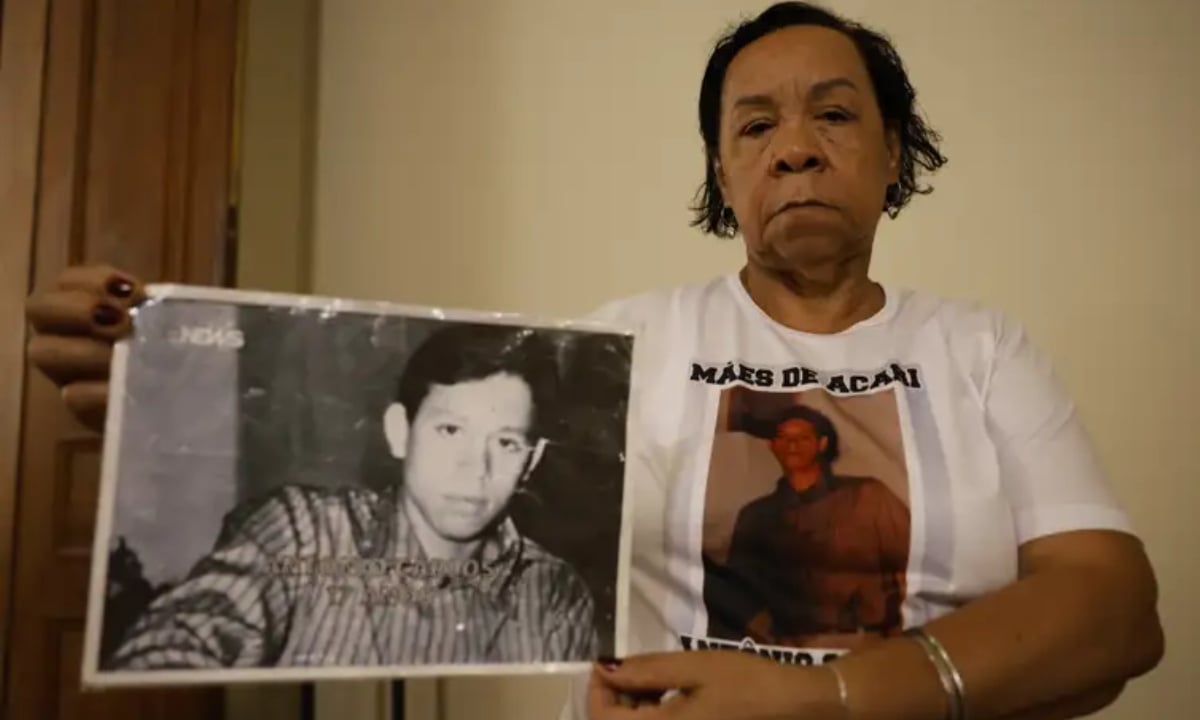
Ana Maria da SIlva Braga, mother of the victim Antônio Carlos da Silva, participates in the public reading of the sentence of conviction of the Brazilian State in the case of the Acari Massacre, published by the Inter-American Court of Human Rights. Photo: Fernando Frazão/Agência Brasil
Heroines of the Fatherland
The approved project also determines the registration of the group called "Mães de Acari" in the Book of Heroes and Heroines of the Fatherland, located in the Panteão da Pátria, in Brasília.
Led by Edméia da Silva Euzébio, mother of Luiz Henrique da Silva Euzébio (16 years old), Vera Lúcia Flores Leite, mother of Cristiane Souza Leite (17 years old), and Marilene Lima de Souza, mother of Rosana Souza Santos (17 years old), they formed the Mothers of Acari movement, which faced threats and prejudice to at least try to find out where the bodies of their children were.
The group of mothers from the north of Rio was received by the First Lady of France, Danielle Mitterrand, and the Secretary General of Amnesty International, Pierre Sane, and became one of the greatest examples of the fight for Justice and reparation in the country.
In addition to the three young people mentioned, the victims of the massacre were Hudson de Oliveira Silva, 16 years old, Edson Souza Costa, 16 years old, Antônio Carlos da Silva, 17 years old, Viviane Rocha da Silva, 13 years old, Wallace Oliveira do Nascimento, 17 years old, Hédio Oliveira do Nascimento, 30 years old, Moisés Santos Cruz, 26 years old, and Luiz Carlos Vasconcelos de Deus, 32 years old.
>> Follow the Agência Brasil channel on WhatsApp
Minimum wage pension
Under the proposal, the family members of the 11 victims will be entitled to a special monthly, lifelong, non-transferable pension as an inheritance, worth one minimum wage (R$ 1,621), which will be paid with resources from the Union's Special Responsibility Compensation and Pensions budget program.
This program is an item in the General Budget of the Union used to pay for the payment of lifetime benefits and compensation granted by the State to victims of political persecution, institutional violence or serious public health crises.
According to the commission, priority will be given to receiving the pension first for ascendants, with emphasis on the victims' mother, followed by descendants in equal shares and, finally, for siblings.
Substitute
The collegiate approved the replacement of the rapporteur, deputy Reimont (PT-RJ), for Bill 1969/22, by deputy Talíria Petrone (Psol-RJ). Although it maintains the content of the original text, the substitute makes technical adjustments to align the granting of benefits with current federal legislation.
The project also started to establish the National Day of Victims of Enforced Disappearances, to be remembered annually on July 26, the date of the kidnapping of the young people. In the rapporteur's assessment, the project is part of a chain of international and national acts that "seek to give the victims of the Acari Massacre and their families a legal and symbolic outcome, within the framework of the protection of human rights, even if decades late".
Reimont also highlighted that the project is in line with recent decisions on the case, such as Brazil's conviction by the Inter-American Court of Human Rights in 2024 and the 2022 Rio de Janeiro state law that also determined compensation.
The project is conclusive and will be analyzed by the Constitution, Justice and Citizenship Commission. But, to become law, it still needs to be approved by the Chamber and the Senate.
🗞️ 2 sources covered this story
📰 Related Articles

Discover 5 typical French recipes to get you in the mood for the World Cup
CartaCapital
Privatization of Copasa is completed in a ceremony at B3
G1 Globo
Ghana goes to court to release Thomas Partey and challenges Canada's veto
CNN Brasil
Woman is found dead on the side of a highway and her ex-partner is arrested
G1 Globo
Police investigate alleged embezzlement after runners report loss in registrations for street race in Varginha, MG
G1 Globo