Parintins Festival 2026: Commerce, economy and the impact of crafts on fashion and style
⚡ Quick Summary
Parintins Festival 2026: Commerce, economy and the impact of crafts on fashion and style The Parintins Festival is the largest open-air folklore show in the world, but its grandeur goes far beyond the three-night dispute between the oxen Caprichoso and Garantido.
Parintins Festival 2026: Commerce, economy and the impact of crafts on fashion and style
The Parintins Festival is the largest open-air folklore show in the world, but its grandeur goes far beyond the three-night dispute between the oxen Caprichoso and Garantido. Behind the spotlight, the event functions as the financial heart of a large production chain supported by dedicated workers: regional artisans.
🔎 In 2026, the traditional festival takes place on the 26th, 27th and 28th of June, and marks another chapter in the centuries-old rivalry between the bois-bumbás.
Academic research carried out at the Federal University of Amazonas (UFAM) in 2024 reveals the enormous economic impact that this activity has on the subsistence and dignity of hundreds of traditional families.
📲 Join the g1 AM channel on WhatsApp
Researcher Egilson da Silva Rocha points out that, for professionals from Parintins, the month of June represents the great opportunity of the year to sell artistic production, generating immediate income and guaranteeing the livelihood of peripheral, riverside and indigenous communities in the region.
The study developed during the institution's Administration course mapped this dynamic and identified how the income of Ilha da Magia workers is distributed and structured:
Concentration in June ("Gold June"): 76.4% of artisans concentrate their sales and revenue almost exclusively during the month of the festival.
Port Tourism: A smaller share, 11.8%, manages to supplement gains throughout the year by taking advantage of stops by foreign tourist cruises in the city's port.
Direct Income and Subsistence: The activity guarantees an average monthly family income established between R$1,500 and R$2,000 for the majority of families living in the sector.
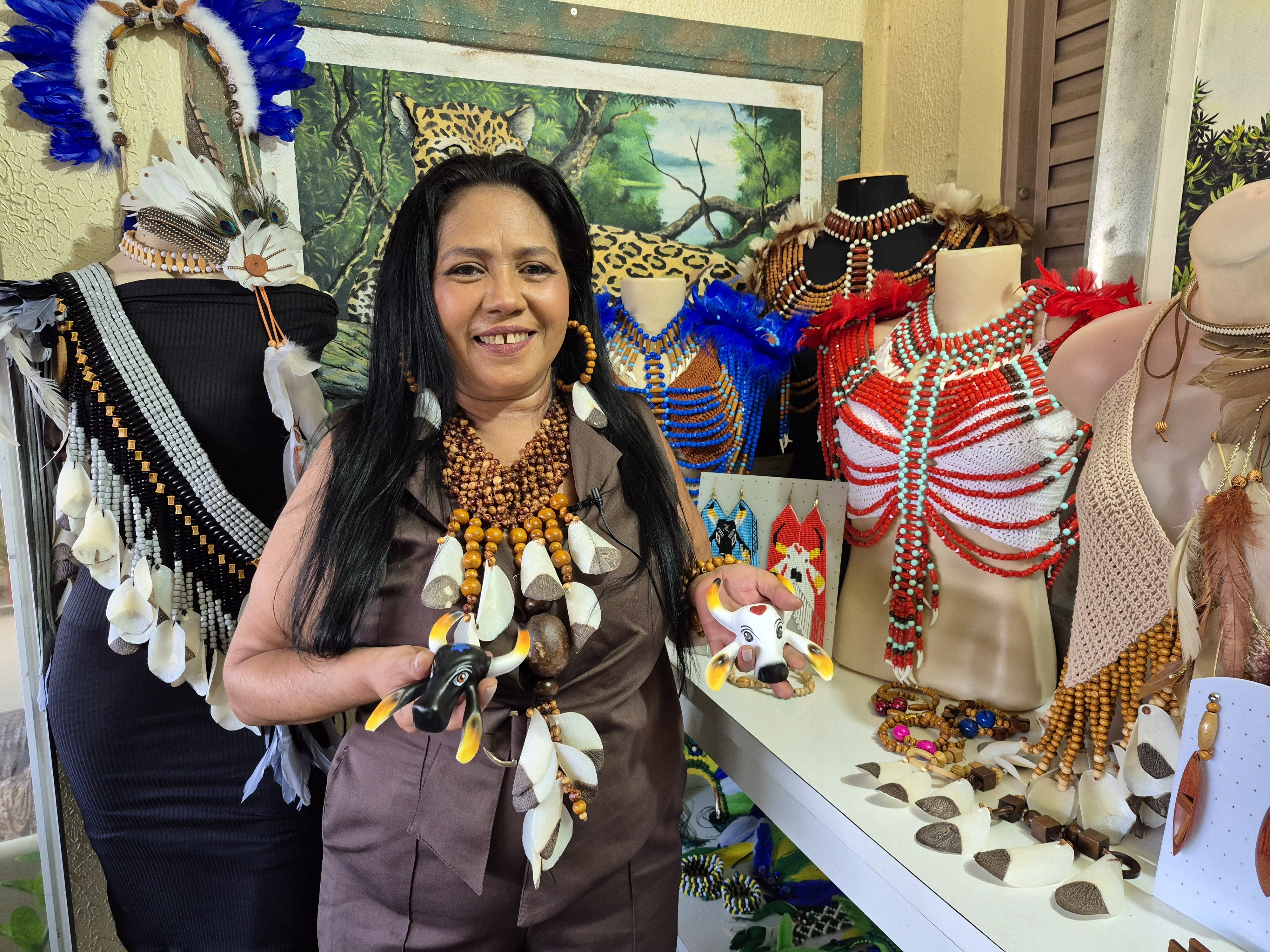
Artisan says she feels excited to participate in the festival's fashion.
Lucas Macedo/g1 Amazonas
Luxury market in the capital: Ateliers are buzzing with pieces worth up to R$1,500
If in Parintins craftsmanship is the basis of livelihood, in the capital, Manaus, the segment has also taken on haute couture and sophistication, transforming ornaments, headdresses and biojewelry into highly coveted luxury items. The search for exclusivity for events leading up to the festival injects robust revenue into urban ateliers.
A clear example of this economic mechanism is artisan Marília Bezerra. Graduated in Science from Ufam, she switched from traditional classrooms to dedicate herself full time to making and teaching crafts. Marília reports that the bumbá season completely transforms the routine of her business, generating an immediate financial increase of up to 30% in household revenue.
"Sales increase a lot, a lot. This weekend there was a party in Manaus and I practically didn't sleep making pieces to deliver. It helps a lot, it gives an increase of 20% to 30% in my household's income", celebrates the artisan.
The prices of pieces in the fashion and style market aimed at the festival vary according to the technical complexity, exclusive design and time invested in manual production:
Hoop or scale earrings: From R$50 (considered the most affordable pieces in the catalogue).
Structured vests: Between R$380 and R$400.
Accessories made with fish scales: Up to R$850 (input with high acquisition and processing costs).
Weave dresses with beads: Between R$1,200 and R$1,500 (exclusive pieces produced on a loom that require five to six days of intense manual work).
The value of the pieces reflects the technical rigor, exclusive design and time invested. For the 2026 Festival, the big fashion trend is the fusion of two passions: the aesthetics of oxen with the colors of the Brazilian Team for the World Cup.
"What takes less time today is the feather earring. A work with a weave that is sewn, done on the loom, takes three to five days to make a piece, like beaded dresses. Our workmanship is detailed. During the festival, I work morning, afternoon, night and early morning. It's point by point, bead by bead", explains Marília, emphasizing that the customer recognizes and pays for the exclusivity seal.
The artisan juggled her routine before dedicating herself entirely to art. Her beginnings in crafts, four years ago, happened completely unpretentiously, when she made the pieces solely for her own use.
The turning point for entrepreneurship began in a common everyday environment: the gym he attended in Manaus.
“It started four years ago, making pieces for myself. I was at the gym and my close friends started asking me to make accessories for them because they thought what I was wearing was cute. In the beginning, I only charged the cost of the material I used. Afterwards, I saw that it was really becoming an extra income for me", recalls Marília.
Job creation and the 'Cunhã Effect' in fashion
Items inspired by cunhãs are made in the studio
Lucas Macedo/g1 Amazonas
The economic impact of crafts is also reflected in the generation of employment and direct income. With the exponential increase in orders, work that was previously solitary starts to move a collaborative network. Marília now hires helpers to keep up with the demand: "I have two people who help me because I can't do it alone anymore. And next year I already want to settle down with someone", he plans.
This "boom" in the consumption of biojewelry and traditional pieces is strongly driven by social networks and by personalities who have become ambassadors of the state's culture, such as cunhãs-porangas and former BBBs Isabelle Nogueira and Marcele Albuquerque.
"We had two phenomena that are dictating and inspiring fashion a lot: Isabelle and Marcele. Everything they use, customers look at it and want it similar. Isabelle uses a lot of fish scales; Marciele brought wooden balls a lot this year. They help our work a lot and value the artisan", he highlights.
READ ALSO
Parintins Festival 2026: composers reveal the secrets behind the crowd's 'hit' songs
Lula praises rivalry between Caprichoso and Garantido and says the festival gives Brazil a 'lesson in civility'
Former BBBs Maxiane, Gabi, Vinicius and Cowboy participate in Arena Planeta Boi at Arena da Amazônia
Marília Bezerra develops original crafts for the Paritins Festival
Lucas Macedo/g1 Amazonas
📰 Related Articles
/https://i.s3.glbimg.com/v1/AUTH_59edd422c0c84a879bd37670ae4f538a/internal_photos/bs/2026/a/9/IU4S9lRayU86UomkCEEQ/14recreio.jpeg)
Explosion in Recreio dos Bandeirantes
G1 Globo
Israeli army attacks Beirut suburbs amid expectations of peace agreement between US and Iran
G1 Globo
Bonfire measuring almost 20 meters maintains a century-old tradition on Saint Anthony's Day in MG; VIDEO
G1 Globo
New visit by Qatar delegation fuels speculation about Iran-US framework agreement
Euronews PT
'Vem pra Orla' returns this Sunday in Santos; check out the attractions and changes in traffic
G1 Globo