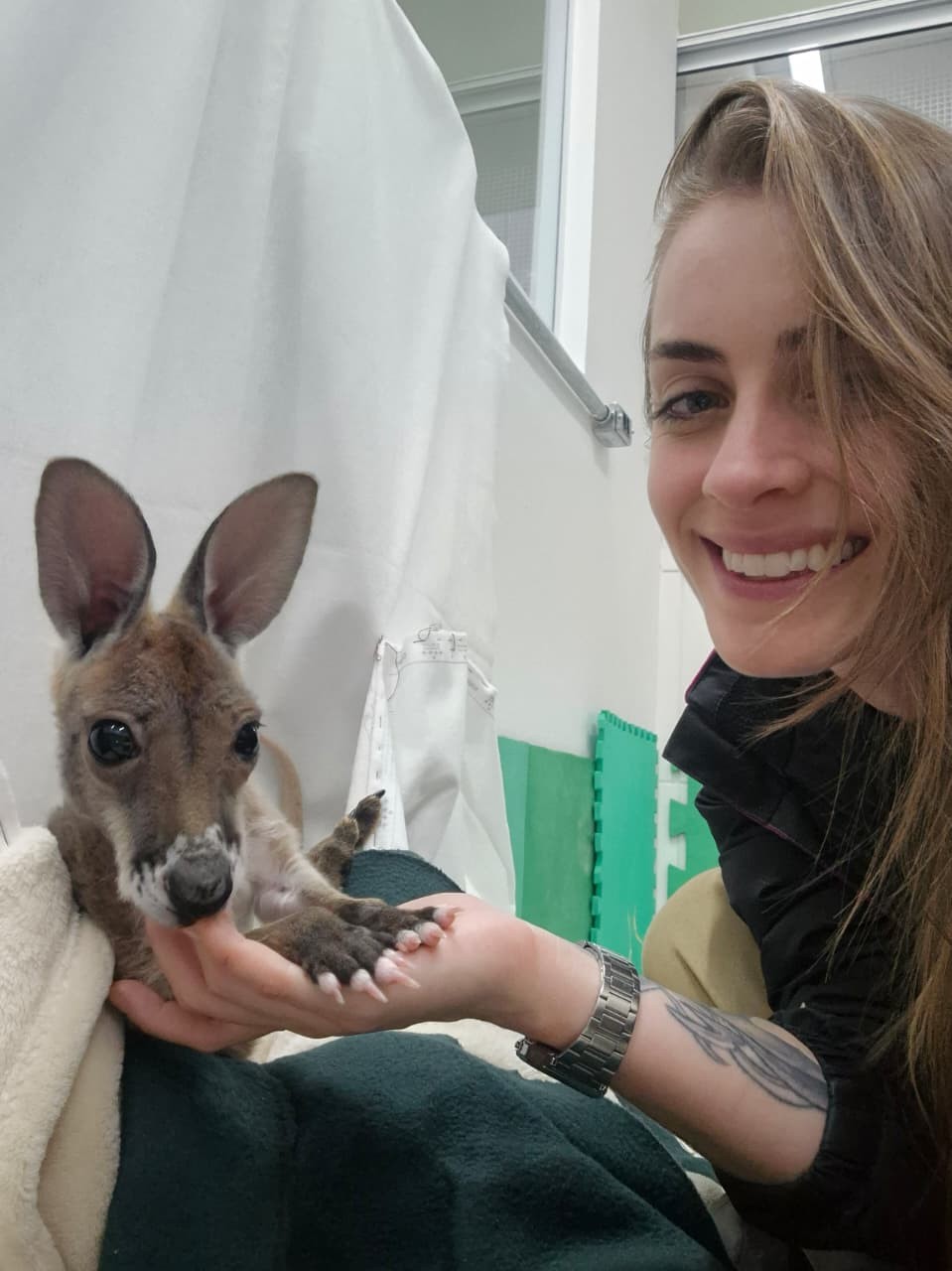
Rejected by its mother, baby kangaroo is 'adopted' by a biologist from Animália Park and receives an artificial pouch: 'She won't be alone'
⚡ Quick Summary
Kangaroo baby rejected at birth gets human 'mother' in SP A baby red kangaroo was rejected shortly after birth, and is being fostered by a biologist, who became its second mother.
Kangaroo baby rejected at birth gets human 'mother' in SP
A baby red kangaroo was rejected shortly after birth, and is being fostered by a biologist, who became its second mother. The case was recorded by the monitoring team at Animália Park, in Cotia, Greater São Paulo.
The biologist is Thais Gomes Amaral, an animal welfare specialist and coordinator of the birds and chicks sector at Animália Park. She says that the situation is considered unusual, but it can happen to any species. After 24 hours, the kangaroo was collected by the team, who made some attempts to reinsert the baby into the mother's pouch, without success.
After the rejection, the baby, who was named Eevee and is around 5 months old, was kept in an adapted fabric bag, used to simulate the mother's bag. According to Thais, the accessory is covered with felt, as it is a material similar to kangaroo fur, and is used throughout daily handling to try to reproduce the species' natural conditions. The animal remains with the biologist most of the time, being carried in the bag throughout the routine.
"It's an unusual situation. The expectation is always that the mother takes care of the puppy, and we do everything we can to ensure that this bond is maintained, because development alongside the mother tends to be much better than when the animal needs to be raised by the team. As the person responsible for the department, I have been monitoring the puppy fully for around 40 days," he said. That's right: Thais has been living in Animália Park all this time with the little kangaroo.
Baby kangaroo from Animália Park
Animalia Park
The case is similar to that recorded in other zoos, such as that of a Japanese macaque baby rejected by its mother in a zoo in Japan, who received intensive human care and attracted attention when appearing in images hugging a stuffed animal.
The cub receives bottle feeding, at intervals of two to three hours, as occurs in the initial phase of the species -- and also very similar to a human baby.
According to the biologist, Eevee still does not consume solid food, but has already started introducing new flavors with carrot juice. “She arrived weighing 900 grams and today weighs around 3.3 kg, with a growth curve as expected,” said Thais.
At this stage, the puppy also began to leave the pouch for short periods to explore the environment, for around 15 to 20 minutes.
According to the biologist, the animal depends on constant contact with a maternal figure, since, in nature, it would remain practically all the time in its mother's pouch.
"She doesn't stay alone. When she notices her absence, she vocalizes and becomes agitated, which is natural," said Thais. Direct care is expected to continue until approximately 1 year of age.
According to the biologist, handling puppies requires individualized monitoring and continuity of care by a single person responsible whenever possible. "Each animal responds in a different way. Therefore, management needs to be adapted and carried out with minimal turnover of caregivers", he stated.
Thais emphasizes that the puppy is showing positive progress. The expectation is that, after the adaptation period and the gain of immunity and autonomy, she will be integrated into the kangaroo enclosure.
Baby kangaroo from Animália Park and the biologist Thais, who welcomed her
Animalia Park
Baby kangaroo from Animália Park
Animalia Park
Visitors to Animália Park observe baby kangaroo
Animalia Park
📰 Related Articles
Sapucaia do Sul Zoo welcomes visitors again after almost a month of closure due to animal deaths
G1 Globo
Elderly man is found tied to a fence after robbery in the floodplain community of Óbidos, in Pará
G1 Globo
Before being revoked, the 'blouse tax' generated more than R$2 billion to the government in 2026
G1 Globo
Military police officers are suspected of using sick leave to work and study in RO
G1 Globo
VIDEOS: MG1 of Saturday, June 13, 2026
G1 Globo