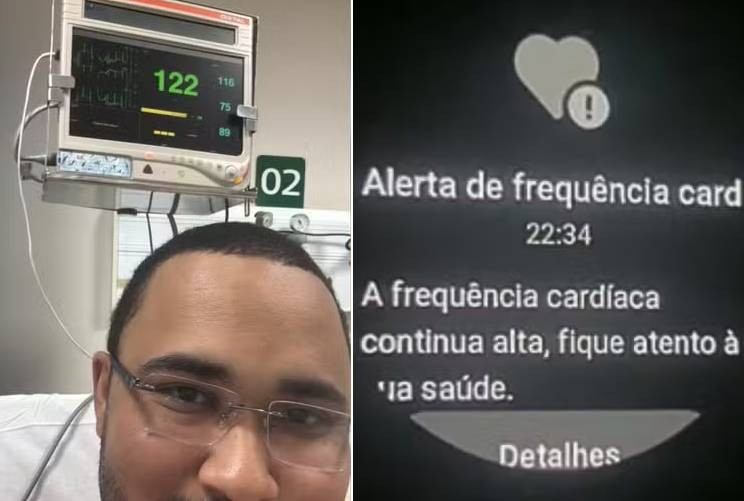
After alert on watch takes 35-year-old analyst to ICU, doctor reinforces that arrhythmias also affect young people
⚡ Quick Summary
Alert on watch for elevated heart rate takes technology analyst to ICU At 35 years old, the technology analyst who received two alerts on his smart watch reporting that his heart rate was above normal is far from the profile that many people associate with heart disease.
Alert on watch for elevated heart rate takes technology analyst to ICU
At 35 years old, the technology analyst who received two alerts on his smart watch reporting that his heart rate was above normal is far from the profile that many people associate with heart disease. Without feeling any symptoms, he went to a hospital in São José do Rio Preto (SP) and discovered that his heart was beating at 160 times per minute.
The case drew attention due to the role of the smartwatch in identifying cardiac changes, but also for another reason: the patient's age. However, the episode also helps debunk a common myth: that heart problems only affect the elderly.
📲 Join the g1 Rio Preto and Araçatuba channel on WhatsApp
Robson de Oliveira Cardoso was lying at home, about to go to sleep, when he received a notification from his smartwatch stating that his heart rate was elevated. An electrocardiogram confirmed the diagnosis of atrial fibrillation, an arrhythmia that can increase the risk of stroke.
🔎 The normal resting heart rate for most healthy adults varies between 60 and 100 beats per minute (bpm), according to a study published by Einstein Hospital Israelita.
Robson de Oliveira Cardoso
Reproduction
According to doctor Luciano Miola, director of the Institute of Cardiovascular Diseases (IMC) in São José do Rio Preto, people of any age group can develop arrhythmias, including children.
This is because, although aging increases the risk, young people are not free from the problem. The doctor explains that some daily habits can favor changes in the heart's rhythm: factors such as a sedentary lifestyle, obesity, stress, anxiety, excessive consumption of alcohol, energy drinks and caffeine are considered risky.
"Arrhythmias can happen at any age. There are cases in children, young adults and the elderly. Aging increases the risk, but it is not a condition exclusive to older people", says the doctor.
Luciano Miola is a cardiologist and director of the IMC in Rio Preto (SP)
Base Hospital/Disclosure
Technology helped with diagnosis
After the diagnosis, Robson was admitted to the ICU for monitoring and carrying out additional tests. He received medication to control the arrhythmia and was released from the hospital the next day.
📱Bookmark g1 on Google and follow the main news of the day
According to Luciano, smart watches have become important allies in the early identification of some heart diseases. Therefore, he has already advised a patient to purchase the device to facilitate control of his heart rhythm.
"I have already made diagnoses based on records sent by patients. Today, there are scientific studies that prove the effectiveness of these devices in detecting arrhythmias, especially atrial fibrillation", says the doctor.
Although the technology helps to identify warning signs, however, the cardiologist reinforces that the devices do not replace medical evaluation or specialized exams.
Robson Cardoso sought medical attention after alert of high heart rate in São José do Rio Preto (SP)
Henrique Souza/g1
Pay attention to the signs
Luciano reinforces that symptoms such as palpitations are often ignored or confused with anxiety and nervousness by many patients, who minimize the signals emitted by their own body.
READ MORE:
Can a smart watch detect heart problems? Understand when the alert on your wrist should become a consultation
Mother of girl who spent 7 years in hospital says adaptation at home was quick
Although Robson did not feel any discomfort, the cardiologist highlights that the absence of symptoms at such high frequencies is not the most common. Despite this, some people may experience arrhythmias without immediately realizing the problem.
"It is very difficult for patients with 160 beats per minute to remain asymptomatic. The most common thing is that they feel palpitations, discomfort in the chest or notice that their heart is racing. It's not impossible not to feel anything, but it's unusual," explains the doctor.
Initial plugin text
See more news from the region on g1 Rio Preto and Araçatuba
VIDEOS: check out the reports from TV TEM
📰 Related Articles

Young woman who became quadriplegic five times is surprised with a marriage proposal after marathon; video
G1 Globo
Enem 2026: registration ends this Friday after deadline extension; fee is R$85
G1 Globo
US and Iran may sign interim agreement on Sunday (14), sources say
CNN Brasil
Tourism project in Rio's favelas prepares special route for the World Cup
Agência Brasil
Path to peace can begin with 14-point memorandum
Observador