Rejected by herd, macaw learns new 'language' and lives for 5 years with a different species in an ancient hole in MS
⚡ Quick Summary
Macaw learns new 'language' and lives with a different species in MS for 5 years Who has never heard that opposites attract? In the skies over Mato Grosso do Sul, the answer seems to be yes.
Macaw learns new 'language' and lives with a different species in MS for 5 years
Who has never heard that opposites attract? In the skies over Mato Grosso do Sul, the answer seems to be yes. See the video above.
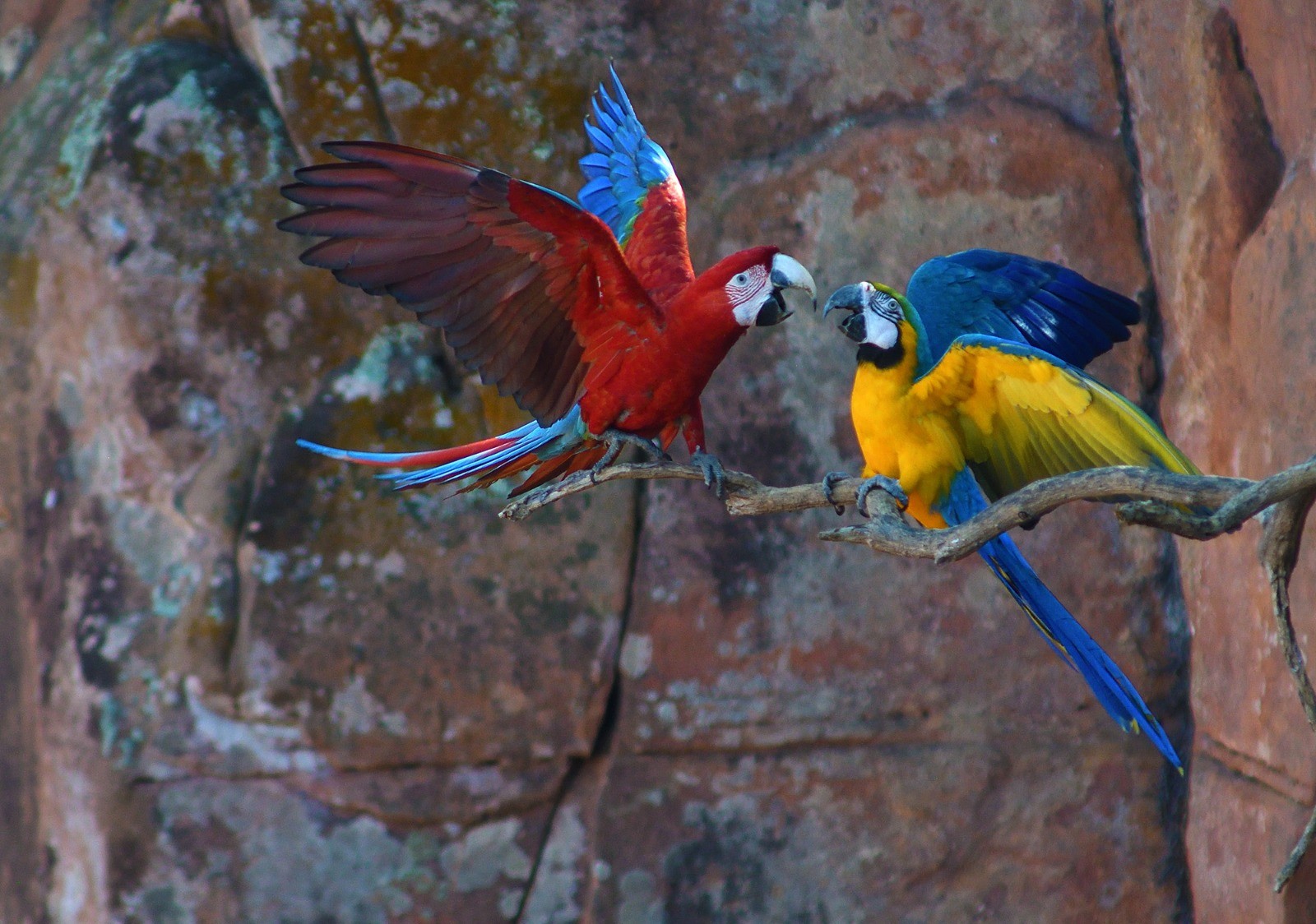
In one of the most impressive settings in the state, a Scarlet Macaw (Ara ararauna) and a Scarlet Macaw (Ara chloropterus) live a story that challenges the species' most common behavior. Monogamous, inseparable and observed together for around five years, they formed a rare couple between birds of different species in an ancient hole, in Jardim (MS).
✅ Click here to follow the g1 MS channel on WhatsApp
Couple of macaws in Jardim.
Buraco das Araras
The relationship, which has Buraco das Araras as its backdrop, draws attention not only because of the difference in colors. While one displays blue and yellow feathers, the other has intense red plumage. In nature, they usually form couples with individuals of their own species. But in this case, the rule appears to have been ignored.
"A love that defies colors and surprises those who visit", summarizes Bergson Sampaio, who has been following the birds' routine in the reserve for years.
Among more than a hundred scarlet macaws that occupy the gigantic natural crater, the duo immediately stands out. And perhaps it is precisely because it is so unlikely that the story arouses so much curiosity.
The bird that needed to learn a new language
The arrival of the Scarlet Macaw at Buraco das Araras happened around seven years ago. At the time, she was a stranger in a territory dominated by scarlet macaws, birds known for their territorial behavior.
According to Bergson Sampaio, the reception was not friendly. "The red ones tried to expel her for six months." But something changed.
Over time, the canindé began to reproduce sounds very similar to those of scarlet macaws. Little by little, she stopped being seen as an invader.
"Her vocalization was very close to the vocalization of the red ones. They started to accept her presence." Accepted by the group, the bird ended up forming a pair with one of the colony's residents. Since then, the two have been seen together frequently.
Five years together and no separation
Scarlet Macaw (Ara ararauna) and a Scarlet Macaw (Ara chloropterus).
José Marques Lopes
Contrary to what many people imagine, macaws tend to be monogamous birds. When they choose a partner, they tend to stay together for long periods.
That's exactly what happened to the couple. For around five years, the two birds have shared territory, flights and routine in Buraco das Araras. To this day there is no record of puppies.
One of the hypotheses is that the physical difference between species makes reproduction difficult. The Scarlet Macaw is larger than the Scarlet Macaw and, depending on the combination between male and female, the crossing can become more complex, explains Buraco das Araras guide, Salete Cinti.
Furthermore, any offspring would be hybrids. In birds, this type of crossing can result in individuals with reproductive difficulties or even sterility. Even so, the absence of descendants did not change the bond observed between them.
A 'lost world' that houses unlikely stories
Infographic shows sinkhole formation process.
g1
The story takes place inside one of the most emblematic places in Mato Grosso do Sul.
Buraco das Araras is a Private Natural Heritage Reserve (RPPN) located in Jardim. The gigantic sinkhole is about 100 meters deep and approximately 500 meters in circumference.
Formed over millions of years, the crater is home to more than 150 species of wild animals, including birds, mammals and reptiles. On the rocky walls, around 120 scarlet macaws find shelter to rest, nest and raise their young.
The place also serves as a refuge for alligators, snakes, bats, monkeys, small mammals and dozens of species of birds. Recognized as RPPN in 2007, the area combines environmental conservation, scientific research, environmental education and sustainable tourism.
Not everything in nature follows the expected script
Ancient hole is home to scarlet macaws and more than 150 species of birds
For those who visit Buraco das Araras, the landscape is usually the main attraction. But, in recent years, they are the ones stealing the spotlight. Among hundreds of birds of the same species, a Scarlet Macaw and a Scarlet Macaw chose to remain together.
Maybe it's just rare behavior. Maybe it's just biology. But it's hard to watch the two fly side by side and not think that, sometimes, even nature likes to defy its own rules.
Watch videos from Mato Grosso do Sul:
🗞️ 1 sources covered this story

📰 Related Articles

"Trump is a manipulator of perceptions and we are wrong"
Observador
Ford presents car made in Spain with hands-free driving
Observador
Lisbon celebrates Saint Anthony with Marches and weddings
Observador
Marisa Monte debuts at Parque do Povo and is a Valentine's Day attraction at São João de Campina Grande this Friday (12)
G1 Globo
Collective wedding with more than 90 couples takes place at the Pyramid of Parque do Povo this Valentine's Day
G1 Globo