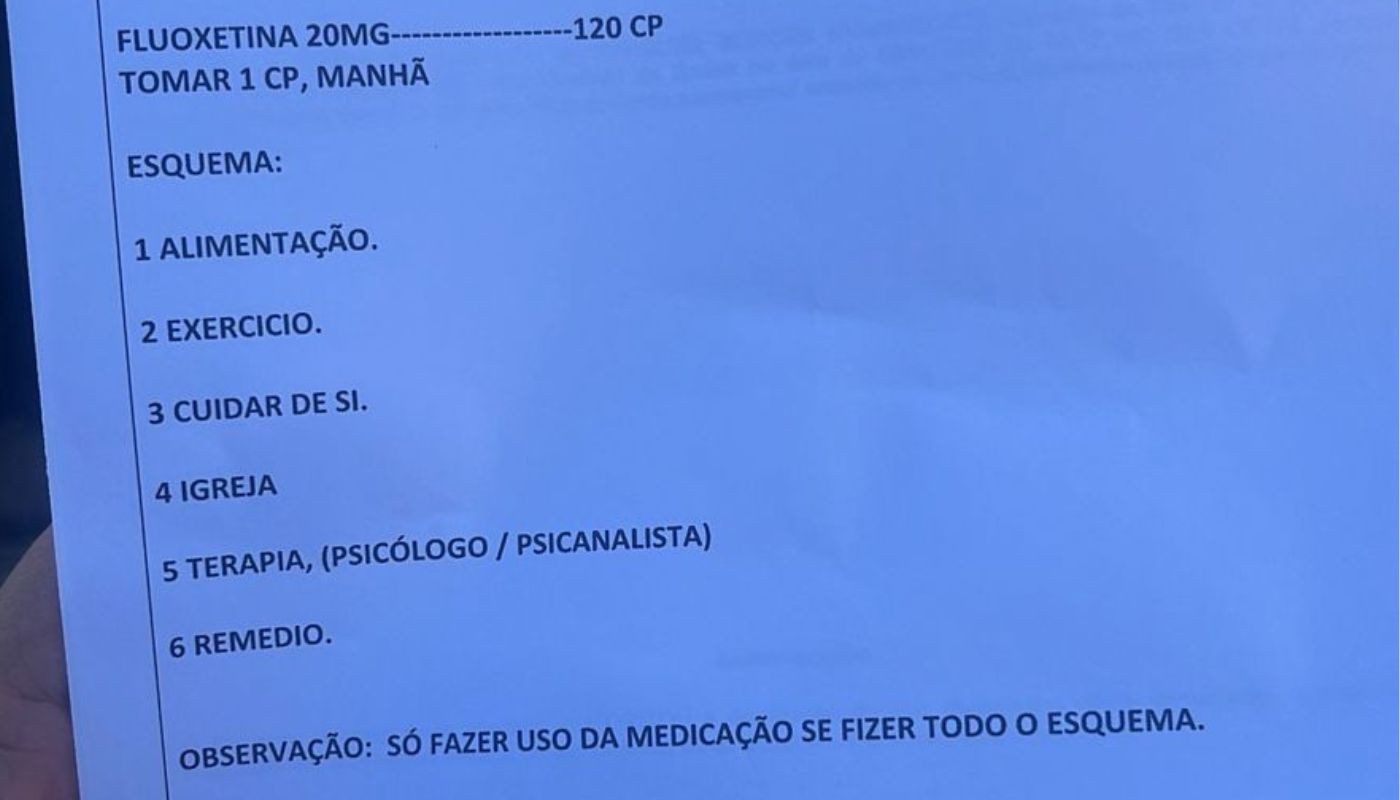
Doctor prescribes 'church' and 'taking care of yourself' in antidepressant prescription for patient in Piracicaba
⚡ Quick Summary
Doctor prescribes 'church' and 'taking care of yourself' in prescription for patient in Piracicaba A public health doctor in Piracicaba (SP) prescribed a treatment plan that included "church" and "taking care of yourself" for a 22-year-old patient complaining of abdominal pain and facial paralysis.
Doctor prescribes 'church' and 'taking care of yourself' in prescription for patient in Piracicaba
A public health doctor in Piracicaba (SP) prescribed a treatment plan that included "church" and "taking care of yourself" for a 22-year-old patient complaining of abdominal pain and facial paralysis.
In the recipe, shared on social media this Wednesday (10), the professional, who associated the symptoms with anxiety, wrote that the young man should take an antidepressant, but only if the other guidelines were followed.
Piracicaba City Hall said it will administratively analyze the conduct, but guaranteed that the patient received a full clinical evaluation at the Vila Sônia Emergency Care Unit (UPA) (see the full note below).
📲 Follow g1 Piracicaba on Instagram
The young man was treated on Monday (8). In the prescription, there is an indication of fluoxetine 20mg followed by the recommendations: "food; exercise; taking care of yourself; church; therapy (psychologist/psychoanalyst); and medicine".
At the end, he wrote: “Note: only use the medication if you follow the entire regimen.”
Medical prescription prescribes 'church' to patient with pain in Piracicaba
Personal file
No history of anxiety
To g1, the patient, who will not be identified in the report, said that he has no history of anxiety and that he did not mention religion during the consultation, nor was he open to this approach, despite being from a Christian family.
He reports that he has been in pain for over a month and without a definitive diagnosis. During the treatment at the UPA, he said that the doctor behaved harshly and stated that it could be a case of anxiety and depression.
In addition to mentioning it in the prescription, the health unit employee would have verbalized the recommendation for religious practice and, according to the patient, belittled the reports of physical pain.
In a note, Piracicaba City Hall stated that this recommendation for religious activities occurred in a complementary way to "strengthen healthy habits, offer emotional support and maintain social and community ties", which, according to the note, can "contribute positively to the well-being of certain people, in accordance with their individual convictions and choices".
The case
The patient said he sought the health unit on Sunday (7) with severe abdominal, ear and head pain, as well as facial paralysis.
During this first appointment, he said he was evaluated by a woman, who medicated him for pain and asked him to return to the unit on Monday for a new evaluation, as there was a change in his kidneys in one of the tests.
Upon returning to the unit, on Monday, he was seen by this other doctor. He described the consultation as harsh and said that, when asked about the kidney problem, the doctor refused to address the issue and diagnosed anxiety.
"He looked at me and said that I didn't have anything, that it was anxiety [...]. I was reluctant at the time, I said 'anxiety?'. He didn't really like that I questioned, that I doubted what he was saying. And then the care stopped being with me. My mother was next door, he started talking only to my mother and ignoring me completely. He started talking to my mother 'Ah, mom, he has anxiety. That could be anxiety'. He started diagnosing me with anxiety, depression", account.
The patient said he received pain medication at the scene and then sought care at another health unit.
Since then, the young man has been using corticosteroids and facial physiotherapy sessions. He also obtained, through the health center, priority referral to a neurologist and gastroenterologist. Furthermore, the family seeks care in the private network.
Entrance to the UPA of Vila Sônia in Piracicaba
Rodrigo Guidi/City Hall
What the city hall says
In a note, Piracicaba City Hall informed that the case will be analyzed administratively, in accordance with the procedures adopted for complaints about care in the municipal health network. The Municipal Health Department also stated that the patient was welcomed and underwent a complete medical evaluation. According to the ministry, medical assistance was not replaced by another type of guidance.
The ministry also said that participation in religious activities was included as a complementary recommendation, with the aim of strengthening healthy habits, offering emotional support and maintaining social and community ties.
Finally, the Municipal Health Department affirmed its commitment to professional ethics, patient autonomy, freedom of belief and the secular nature of the public service, highlighting that any form of religious imposition in the care provided by the municipal network is not permissible.
See the note in full:
The Municipal Health Department of Piracicaba informs that it has become aware of the aforementioned publication and clarifies that the case will be analyzed administratively, in accordance with the institutional flows applicable to all manifestations related to assistance provided in the municipal health network.
In relation to the care provided, the care records demonstrate that the patient was regularly received, underwent a complete medical evaluation, including anamnesis, physical examination, analysis of available tests, diagnostic definition, administration of medications during care and therapeutic prescription for continuity of treatment. There was, therefore, no replacement of medical assistance with any other form of guidance.
It should also be clarified that the service was not restricted to issuing prescriptions or general recommendations. The patient received a comprehensive clinical assessment, symptomatic treatment, medical guidance and referral for follow-up within the health care network, according to the need identified during the consultation. The recommendations recorded by the professional must be understood within this broad care context and not isolated or dissociated from the care actually provided.
Modern medicine recognizes the importance of biological, psychological and social aspects involved in the health-disease process. In this context, factors such as adequate nutrition, regular physical activity, strengthening family and community ties, psychological support and individual emotional coping strategies can act in a complementary way to medical treatment, contributing to the promotion of health and quality of life, without replacing scientifically established therapies.
Regarding the published prescription, it is observed that the professional recorded, in addition to the medication prescription, a set of recommendations aimed at self-care and health promotion, including adequate nutrition, physical activity, personal care and psychological support.
The reference to participation in religious activities was inserted in this broader context of strengthening healthy habits, emotional support and maintaining social and community ties, aspects that can contribute positively to the well-being of certain people, according to their individual convictions and choices.
It is important to highlight that this guidance was not presented as medical treatment, nor as a replacement for prescribed therapy, but as a complementary recommendation included in a set of measures aimed at comprehensive health promotion.
The Municipal Health Secretariat reaffirms its commitment to the principles of professional ethics, patient autonomy, freedom of belief and secular public service, with any form of religious imposition not being permissible within the scope of assistance provided by the municipal network.
Finally, it informs that the case will be evaluated by the competent technical area to analyze the full context of care and verify compliance of the registered guidelines with the institutional guidelines adopted by the Municipal Health Department. Aerial image of the Piracicaba Municipal Palace building
Piracicaba City Hall
What Cremesp says
g1 contacted the Regional Council of Medicine of the State of São Paulo (Cremesp) to find out what the limits of this type of conduct are and whether the doctor mentioned is being investigated, but received no response until the last update of this report.
*Under the supervision of Yasmin Moscoski
VIDEOS: everything about Piracicaba and the region
See more news about the region at g1 Piracicaba
📰 Related Articles

"Trump is a manipulator of perceptions and we are wrong"
Observador
The population can choose proposals from the Participatory Budget starting this Friday (12); more than 800 proposals in 5 cities in PI
G1 Globo
Ford presents car made in Spain with hands-free driving
Observador
Lisbon celebrates Saint Anthony with Marches and weddings
Observador
Marisa Monte debuts at Parque do Povo and is a Valentine's Day attraction at São João de Campina Grande this Friday (12)
G1 Globo