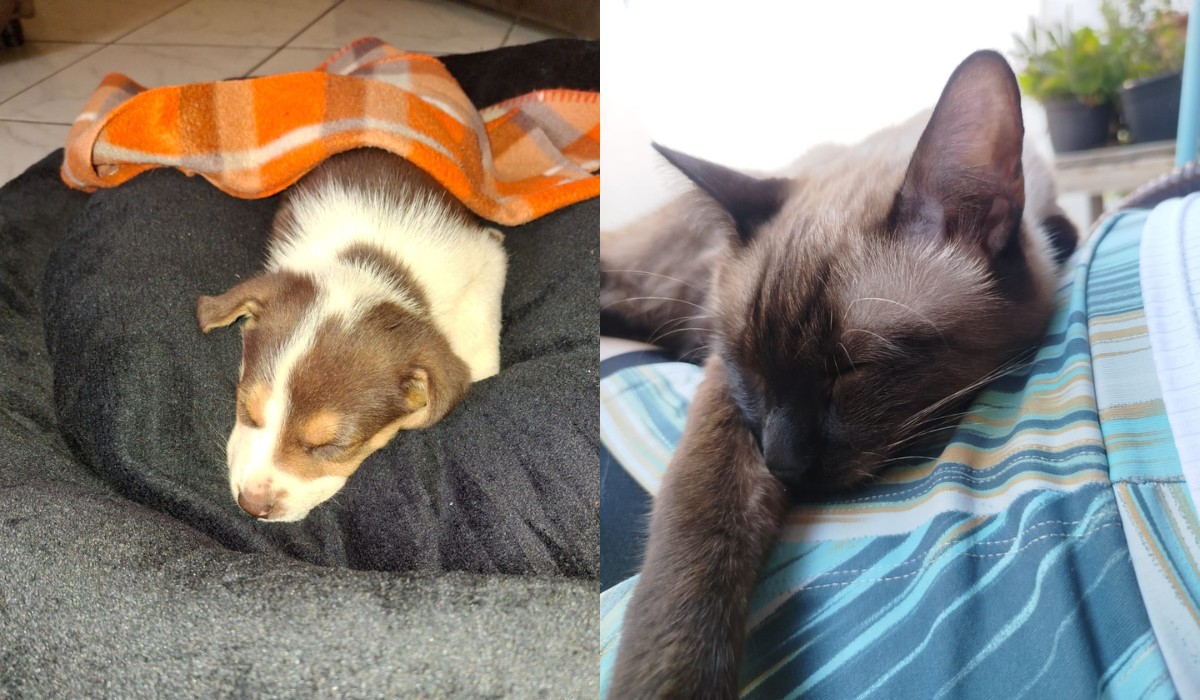
Do dogs and cats dream? Science explains what happens in pets' brains during sleep
⚡ Quick Summary
Veterinarian explains what happens in pets' brains during sleep Who has never observed a dog moving its paws while sleeping or a cat making small sounds in its sleep and wondered: could it be dreaming?
Do dogs and cats dream? Veterinarian explains what happens in pets' brains during sleep
Who has never observed a dog moving its paws while sleeping or a cat making small sounds in its sleep and wondered: could it be dreaming? According to science, the answer is yes.
According to veterinary neurologist Thaís Angeloni, from Presidente Prudente (SP), scientific evidence strongly indicates that dogs and cats dream.
📲 Join the g1 Presidente Prudente e Região channel on WhatsApp
The conclusion was reached through studies that analyzed the electrical brain activity of animals during sleep.
"What we know is that mammals share brain structures and sleep patterns similar to those of humans. Researchers reached this conclusion through electroencephalographic (EEG) studies that evaluate brain electrical activity during sleep," explained the veterinarian.
Thais Angeloni is a veterinary neurologist in Presidente Prudente
Thais Angeloni/Personal Archive
According to the expert, the fact that animals do not have the same human rationality does not prevent them from dreaming.
"Scientific evidence strongly indicates that dogs and cats dream. The term 'irrational' is not the most appropriate from a biological point of view, because animals have different forms of cognition, learning, memory and information processing", he reinforced.
Just like people, dogs and cats sleep is divided into different phases. Animals go through periods of light sleep, deep sleep and so-called REM (Rapid Eye Movement) sleep, a phase in which the brain shows intense activity.
"In different stages, including light sleep, deep sleep, and REM sleep phases. Although the duration and distribution of these stages vary between species, the basic architecture of sleep is similar [to humans]."
READ ALSO
New wild animal rehabilitation centers should start operating by 2028 in the interior of SP
Community dog is found dead with a branch in its mouth and the case is investigated by the police in the interior of SP
With trails and games, the nursery promotes environmental education for children in Presidente Venceslau
Science has already proven that dogs and cats dream while they sleep
Personal Archive/Images Provided
What happens in the brain during sleep?
Even when the body seems completely relaxed, the brain continues to work. During sleep, intense information processing, memory consolidation and integration of lived experiences occur.
At the same time, the body reduces muscle tone, a mechanism that prevents the animal from physically executing everything it is "living" during the dream.
"While the brain is active, there is a reduction in muscle tone, a mechanism that helps prevent the animal from physically executing the movements associated with the content of the dream," said Thaís.
Even so, small movements of the paws, muscle contractions, facial tremors, movement of the eyes under the eyelids, wagging of the tail and even vocalizations can occur during dreams. In cats, it is also common to observe movements of the whiskers, ears and paws.
According to the veterinarian, these behaviors are considered normal during deep sleep.
"Although during REM sleep there is a significant reduction in muscle tone, to prevent the animal from physically executing its dreams, this inhibition is not complete. Small movements can occur normally and are part of the physiology of sleep", he explained.
Science has already proven that dogs and cats dream while they sleep
Adolfo Campos/Personal Archive
What do animals dream about?
Despite advances in neuroscience, there is still no technology capable of accurately identifying the content of dogs and cats' dreams.
What researchers are able to observe are brain patterns compatible with dream activity. Even without knowing exactly what goes through pets' minds, experts believe that dreams are related to recent experiences.
"Neuroscience studies demonstrate that the brain uses sleep to store memories and process recent experiences. Therefore, we can say that dreams can reflect activities, stimuli and interactions experienced throughout the day", said the expert.
This means that that dog who spent hours chasing a ball or playing in the yard can, in a way, relive those experiences while he sleeps.
But, just as they can form memories and associate emotions with lived experiences, dogs and cats can also have unpleasant dreams.
Although it is not possible to confirm when an animal is having a nightmare, experts believe that negative experiences can influence the contents processed during sleep.
Science has already proven that dogs and cats dream while they sleep
Stephanie Fonseca/g1
What to do when pets are dreaming?
According to the neurologist, the ideal is to allow the animal to naturally complete the sleep cycle. In addition to interrupting an important moment for the brain, waking your pet up suddenly can cause fright and disorientation.
"The ideal is to allow the animal to naturally complete the sleep cycle, so in most situations it does not need to be woken up. Just like us, animals can wake up scared, confused or react defensively for a few seconds," he said.
Although slight movements are considered normal, some signs require attention. Intense muscle rigidity, frequent episodes, excessive salivation, prolonged loss of consciousness or behavioral changes after waking up may indicate neurological problems, such as seizures.
In these cases, the recommendation is to record the episodes on video and seek veterinary care.
"Recording videos can be very useful for the veterinarian to carry out the assessment; if the movements are very intense, frequent or accompanied by other clinical signs, it is very important to seek professional guidance", warned the specialist.
Quality sleep
In addition to curiosity about dreams, experts reinforce that sleeping well is essential for the health of animals.
Adequate sleep contributes to the functioning of the nervous system, memory, learning, hormonal balance, immunity and emotional well-being.
Therefore, offering a calm, comfortable and stress-free environment is one of the simplest ways to take care of your pets' quality of life.
"The biggest curiosity may be that animals have sleep stages very similar to ours and have brain activity compatible with the formation of dreams. This reinforces that the fundamental brain mechanisms of sleep are shared between different species of mammals", concluded the neurologist.
Thais Angeloni is a neurological veterinarian in Presidente Prudente
Thais Angeloni/Personal Archive
*Collaborated under the supervision of Stephanie Fonseca
Initial plugin text
See more news on g1 Presidente Prudente and Region
VIDEOS: watch TV TEM reports
📰 Related Articles

Plug-in solar energy: the innovation that promises to transform domestic consumption
CartaCapital
Best air fryer to match your kitchen? Line focuses on colors and design
CartaCapital
Best low-cost upright vacuum cleaners for those who live alone
CartaCapital
Los Angeles stadium workers call off strike
Observador
Bus passengers detain and tie up a man who made obscene gestures at women on a street in Fortaleza
G1 Globo