


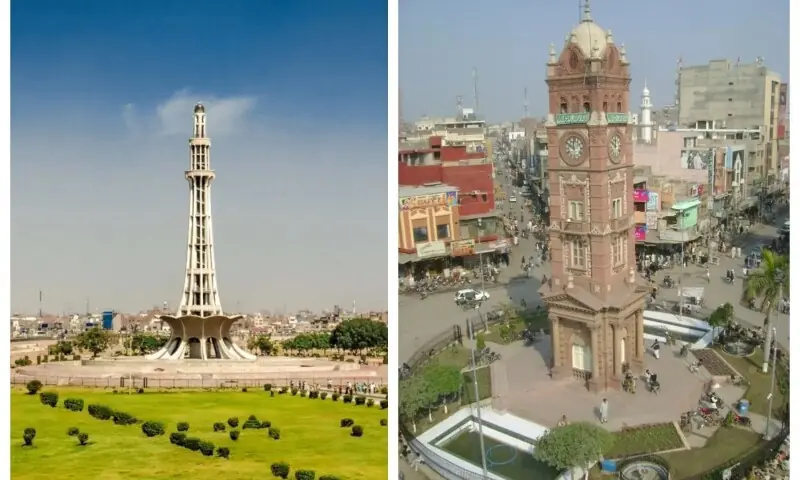
Claims of Lahore and Faisalabad en route to rank among world's hottest cities by 2050 are misleading
⚡ Quick Summary
Since June 7, 2026, several local digital media pages on X, Facebook and Instagram have been claiming that Lahore and Faisalabad were en route to rank among the world’s hottest cities by 2050.
Since June 7, 2026, several local digital media pages on X, Facebook and Instagram have been claiming that Lahore and Faisalabad were en route to rank among the world’s hottest cities by 2050. However, the claim is misleading.
On June 7, the Pakistan Meteorological Department (PMD) released an advisory, warning that a heatwave would engulf the country until June 12, with temperatures rising by seven degrees Celsius above normal. It predicted that a high-pressure system was likely to develop and persist in the upper atmosphere.
The PMD warned that night-time temperatures were also likely to rise, while dust storms may occur at isolated places in southern Punjab and Sindh. The department further advised that children, women and senior citizens should exercise extra caution during the heatwave.
Since June 7, several local digital media pages have been claiming that Lahore and Faisalabad were projected to rank among the world’s hottest cities by 2050. The posts were accompanied by AI-generated imagery showing the mercury rising to alarming levels, as seen here, here, here, here and here.
Similar news reports were also run by local news outlets Bol News, Dunya, The Nation and ProPakistani on their websites.
All of these social media posts and news reports cited a “climate study” but did not provide its name, the date it was published, or a link to the same.
A keyword search conducted to corroborate whether any credible domestic or international media outlets had reported the alleged development did not yield any results. Similarly, a keyword search for the original study cited in the aforementioned reports did not yield any peer-reviewed paper or institutional report.
Instead, the search results led to a March 2026 study by the University of Chicago’s Climate Impact Lab — covered by Dawn — which projected that Pakistan could see a net increase of 51 temperature-related deaths per 100,000 people by 2050. It further stated that Faisalabad, Lahore, Multan, Gujranwala, Peshawar, Hyderabad, Rawalpindi and Islamabad were among the most heat-vulnerable cities globally.
The study was also covered by other news outlets such as Earth.Org and Time Magazine in March.
It is important to mention that the Climate Impact Lab study was a mortality risk ranking and not a temperature ranking. In its executive summary, the report directly states: “Understanding how a warming climate will impact mortality isn’t as simple as looking at what areas of the world will be the hottest.”
It measures projected changes in net temperature-related death rates in 2050 compared to the 2001–2010 average. The variables driving vulnerability are income levels, capacity for autonomous adaptation such as access to cooling and the ability to adjust behaviour, and existing heat exposure, not which cities will record the highest thermometer readings.
The study ranked Faisalabad among cities in low- and lower-middle-income countries, with a projected increase of 81 additional deaths per 100,000 people annually by 2050. Multan was ranked second at 72, Gujranwala third at 67, and Lahore fourth at 55.
The report further noted that of the more than 100,000 additional heat-related deaths projected each year globally across 301 cities, approximately 1 in 3 will occur in Pakistani cities. At the country level, Pakistan ranks fourth globally with a projected net increase of 51 deaths per 100,000 — behind Niger, Burkina Faso, and Djibouti.
Fatima Yamin, a climate change and disaster management expert, also told iVerify Pakistan that the study published by the Climate Impact Lab was on the amount of heat-related deaths around the world and countries were ranked accordingly. “Pakistan has always been, for the last few years, in the top five countries in the world most vulnerable to climate change and based on that they have made this scale.”
The study in question, she reiterated, elaborated on how heat-related deaths were projected to grow in Pakistan.
Therefore, the claim that Lahore and Faisalabad are projected to be among the world’s hottest cities by 2050 is misleading.
Pakistani cities face some of the steepest projected rises in heat-related mortality in the world by mid-century. But that is a measure of vulnerability and not temperature.
This fact check was originally published by iVerify Pakistan — a project of CEJ-IBA and UNDP.
📰 Related Articles

Tinubu does not have to resign, let Nigerians decide at the polls – APC chieftain, Aliyu
Daily Post Nigeria
US rains Hellfire missiles on Jalveer crewed by 20 Indians, says blockade impartial
India Today
How BJP’s four-hour legal sprint derailed Meenakshi Natarajan’s Rajya Sabha bid
The Hindu
BREAKING: Reps pass bill for establishment of state police
Premium Times
Russian tech firm unveils Katyusha ground robotic vehicles at Fleet 2026 naval show
TASS