


Elections in Peru: counting enters the fourth day with 98% of ballot boxes counted, but with no defined winner
⚡ Quick Summary
'The country of endless counting': why does the election result in Peru take so long?
'The country of endless counting': why does the election result in Peru take so long?
Peru has been counting votes for the second round of elections for four days, but the country still does not know whether the next president will be left-wing deputy Roberto Sánchez or right-wing leader Keiko Fujimori.
📱Bookmark g1 on Google and follow the main news of the day.
At midnight this Thursday (10), with virtually 98% of the ballots counted, the difference between the two candidates is just under 7 thousand votes in favor of Sánchez.
The left-wing deputy is ahead with 50.019% of the votes, while the conservative one has 49.981%.
See the investigation timeline below:
Election stamp in Peru
Art Editor/g1
The first official data from the count was released around 10pm on Sunday (7) by the Peruvian electoral body: Keiko Fujimori came out on top, five percentage points ahead of Roberto Sánchez.
The difference between the two decreased as the investigation progressed. At around 7am on Monday (8), Keiko had less than a point advantage over Sánchez.
At 1:07 pm on Monday, local time, the Juntos pelo Peru candidate overtook Keiko. Since then, Sánchez has remained at the forefront.
This Wednesday, 98.207% of the ballot boxes in Peru had already been opened and counted. Abroad, the count is at 67.36%, with Keiko Fujimori well ahead of his opponent, with 62.46% of the votes against 37.54%.
The electoral authority reported that the release of the final result could take days. Voting in Peru is done with paper ballots. The country has 27.33 million voters eligible to vote.
Now on g1
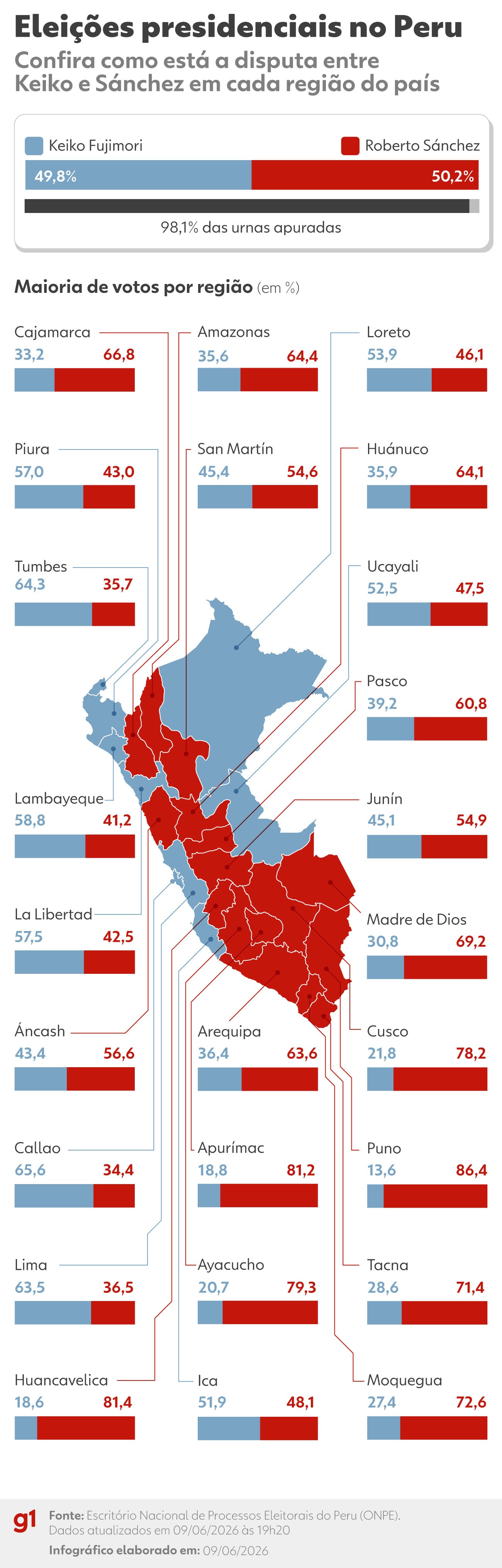
Check the performance of the candidates in each Peruvian region on the map this Tuesday (9):
Map shows voting by Roberto Sánchez and Keiko Fujimori in each region of Peru.
Art/g1
Candidates' profile
Keiko Fujimori is running for the Força Popular party, a party she founded in 2008 to lead the Fujimorist movement. Daughter of former president Alberto Fujimori, the candidate is running for president for the fourth time, having been defeated in the second round in the 2011, 2016 and 2021 elections.
In the first round vote in 2026, Keiko obtained 17.2% of the valid votes.
Keiko Fujimori (left) and Roberto Sánchez (right).
Stifs Paucca and Angela Ponce / Reuters
Representative Roberto Sánchez, from Juntos pelo Peru, reached the second round after obtaining 12% of the votes in the first round.
Sánchez's support base is mainly identified in rural areas and areas far from urban regions.
History and electoral context
The 2026 elections saw a record 35 presidential candidates in the first round. The process takes place in a scenario in which Peru has registered 9 presidents in 10 years, and constitutional terms should be five years.
Survey data indicate that 90% of Peruvians express little or no confidence in the government and the National Congress.
Furthermore, only 10% of Peruvians say they are satisfied with democracy in the country, a situation that researchers classify as "chronic distrust".
📰 Related Articles

Heat. All mainland districts under yellow warning
Observador
Floods in Indonesia killed 7% of the rare orangutan population
CNN Brasil
Progress in reducing the age of majority becomes ammunition for the opposition in the elections
CNN Brasil
PSU will force disabled young people into social work
Observador