Three die in Kenya in protests against US Ebola center
⚡ Quick Summary
Protests in Kenya against the construction of a center to quarantine Americans exposed to the Ebola virus on the African continent result in three deaths.
Protests in Kenya against the construction of a center to quarantine Americans exposed to the Ebola virus on the African continent result in three deaths. The agreement between the United States (USA) and Kenya has had repercussions in the East African country, where the population fears a risk to public health with the transfer of Americans exposed to the virus.
With about 56 million people, Kenya borders Uganda, one of the sites of the Ebola outbreak. The other country where cases have been recorded is the Democratic Republic of Congo (DRC). Due to its proximity to the epicenters of the outbreak, the World Health Organization (WHO) considers Kenya one of the countries at risk of contamination.
Related news:
Democratic Republic of Congo confirms 71 more cases of Ebola.
WHO and CDC Africa launch response plan to the Ebola outbreak in the region.
Ebola: WHO raises the risk to very high in the Democratic Republic of Congo.
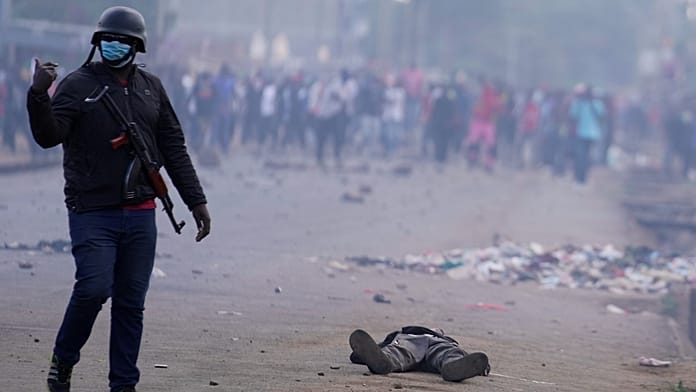
This Tuesday (9), protesters reported the murder of yet another person in a protest in Nairobi, the country's capital, against the installation of the quarantine center linked to the USA. Last week, two other people were killed in protests for the same reason, according to the Kenya Human Rights Commission (KHRC).
"Police deployed in Nairobi shot and killed a protester. Residents took to the streets demanding transparency about the US-backed Ebola facility and solid guarantees for the protection of public health," says a statement from the non-governmental organization.
The coordinator of the ESPM's Center for African Studies and Business (Nenaf), Natalia Fingermann, explained to Agência Brasil that Kenya has not yet registered any case of Ebola, but that the population fears the installation of this center, the result of an agreement with Donald Trump's government. Details of this agreement remain confidential.
"The Kenyan government secretly chose to make this agreement with the Trump administration to create a quarantine center for all North American citizens in African territory who had any type of suspicion of Ebola. It is logical that the youth, and the population of Nairobi, were very apprehensive", he comments.
The agreement was revealed in a communication from the Trump administration about the help provided by the White House to the African continent to face the latest Ebola outbreak, which was classified by the World Health Organization (WHO) as a global emergency.
“This issue puts the public health of the population at risk because no one knows how this construction will be carried out, where it will be and what the conditions will be”, added the professor of international relations at ESPM.
In this context, the Nairobi High Court issued a precautionary order suspending the installation of the quarantine center, scheduled to be set up in Laikipia, about 150 kilometers from the capital. Local media claim that the center would have 50 beds with plans to expand up to 250 beds.
“The court specifically prohibited the defendants from admitting, transferring, receiving or facilitating the entry into Kenya of people exposed to or infected with the Ebola virus in accordance with the reported agreement with the US,” Kenyans newspaper said.
In a statement, the US Embassy in Kenya stated that it is working to resolve any obstacles to the joint response of the two countries against the Ebola outbreak.
“The bioisolation unit in Laikipia is part of a comprehensive response to prevent the spread of the disease and reduce health risks throughout the region; it does not pose a risk to neighboring communities,” said Washington's representation in Kenya.
According to professor Natalia Fingermann, the president of Kenya, William Ruto, has had a policy closely aligned with the Western agenda in the region, with certain authoritarian characteristics.
“Kenya has already had a few weeks of protests against the government, in particular due to the increase in fuel prices”, he added. The price of gasoline has been rising in Kenya in the context of the war against Iran, which has been disrupting the oil market around the world.
Ebola outbreak
Health authorities in African countries, in partnership with international organizations and other countries, are struggling to contain the outbreak of the rare Bundibugyo strain, for which there is still no vaccine or treatment. The outbreak, which is the third largest on record, had been advancing faster than the global response.
The African Union and the World Health Organization (WHO) published a plan to contain the spread of the virus, considered highly deadly. As of June 8, 626 confirmed cases had been recorded in the Democratic Republic of Congo (DRC), with 112 deaths associated with the virus; in addition to 19 cases and two deaths confirmed in Uganda.
The data is consolidated by the African Union's Center for Disease Control and Prevention (CDC), fed by data from the ministries of health in the DRC and Uganda.
🗞️ 1 sources covered this story
📰 Related Articles
Three people die after collision between car and truck on BR-110, in Bahia
G1 Globo
Fire rages in Odemira with an active front
Observador
Extraordinary Canada takes largest Brazilian delegation in nine years
G1 Globo
Iran president says US threats demonstrate weakness
CNN Brasil
Country Bulls Rodeo 2026 will have 5 days of celebration, national shows and solidarity income for hospitals; see attractions
G1 Globo