Trump says US conducted secret operation in Hormuz to free oil tankers
⚡ Quick Summary
US attacks Iran in retaliation for the downing of an American helicopter in the Strait of Hormuz US President Donald Trump stated this Wednesday (10) in a post on his social network that the US carried out a secret mission last month to allow oil tankers to pass through the Strait of Hormuz, currently blocked by Iran.
US attacks Iran in retaliation for the downing of an American helicopter in the Strait of Hormuz
US President Donald Trump stated this Wednesday (10) in a post on his social network that the US carried out a secret mission last month to allow oil tankers to pass through the Strait of Hormuz, currently blocked by Iran.
✅ Follow the g1 international news channel on WhatsApp
As a result, more than 100 million barrels of oil were drained and more than 200 commercial ships made the crossing, according to Trump.
"This extremely successful effort is due to the fact that the UNITED STATES of AMERICA CONTROLS the Strait of Hormuz — NOT Iran. Their military forces are defeated and their economy is lost. It's over for Iran!" Trump wrote.
Trump promises new attack
Earlier, Trump stated that he will attack Iran again this Wednesday (10) and that the new attack will be "very strong".
"We came down hard on them yesterday, and we're going to come down hard on them again today," Trump told reporters in the White House's Oval Office. "They should have signed an agreement."
➡️ Despite the ceasefire in force, the United States and Iran exchanged attacks again on Tuesday (9). US forces bombed defense systems and radars in the Strait of Hormuz, and Tehran responded by launching missiles at a US base in Bahrain (read more below). Trump claimed to have retaliated against Iran for shooting down a US military helicopter that was flying over Hormuz.
Earlier, through his social network Truth Social, the US president called Iran a "bully of the Middle East" and made new threats, stating that the country will now have to "pay the price" for not having accepted a peace agreement.
"Iran's Armed Forces are complete chaos. Most of them, like the Navy and Air Force, don't even exist anymore – they have been completely defeated. Iran is all talk and no action. The bully of the Middle East is DEAD!!! They took too long to negotiate a deal that would have been great for them, now they will have to pay the price!!!", wrote Trump.
Shortly after the statement, the US president also gave an interview to US broadcaster Fox News, in which he announced that he was close to ordering new attacks on Iran's power plants and bridges.
According to a source from the Reuters news agency, Qatari negotiators traveled to Tehran this Wednesday morning in an attempt to finalize an agreement, after consultations with the United States.
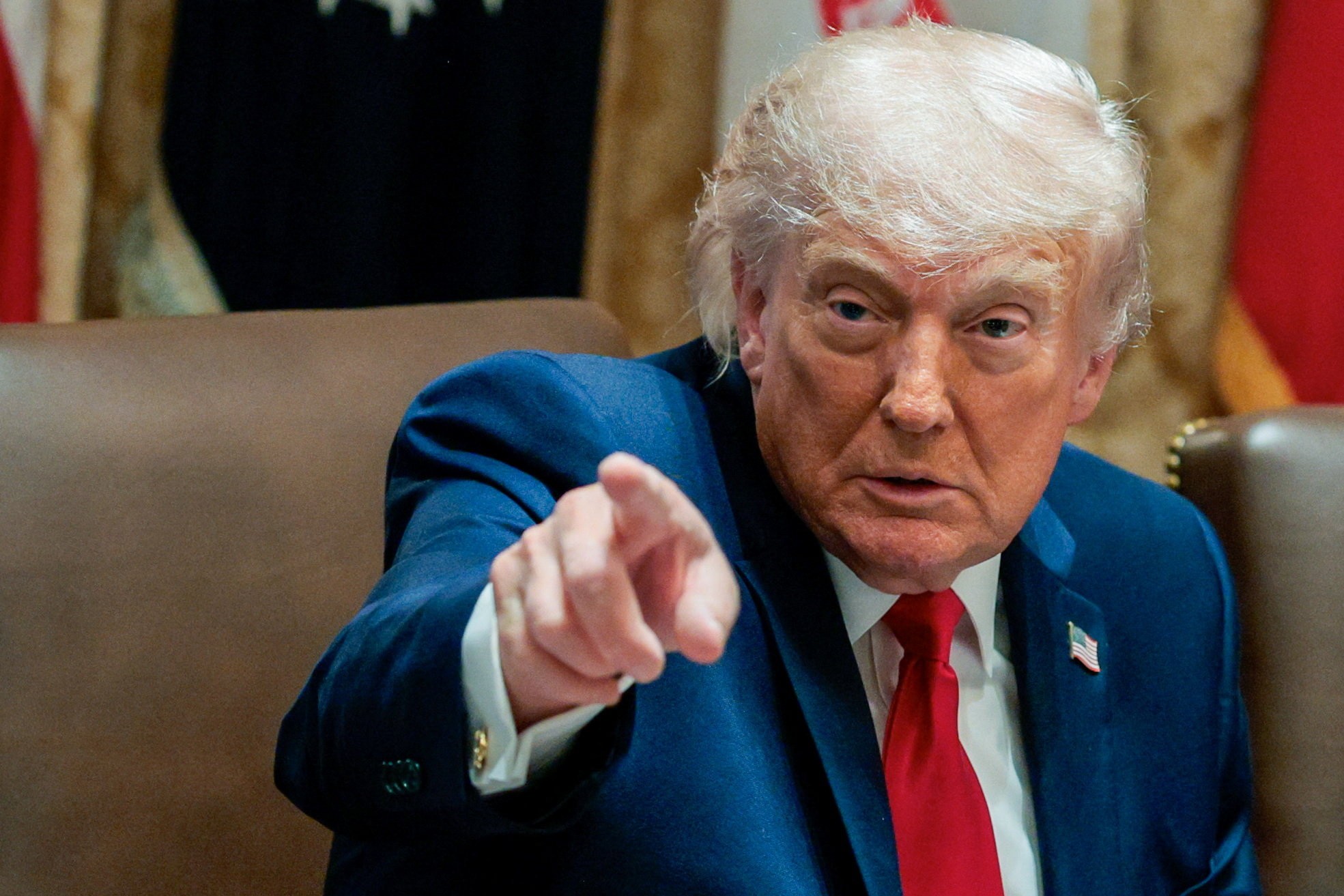
US President Donald Trump points his finger during a cabinet meeting in the White House Cabinet Room in Washington, DC, US on May 27, 2026
REUTERS/Evan Vucci
Exchange of attacks
This Tuesday (9), the United States carried out a series of bombings against Iranian territory, in retaliation for the downing of an Apache helicopter in the Strait of Hormuz region the previous day.
Iran, in turn, responded with attacks on the US Fifth Naval Fleet, stationed in Bahrain, according to state media.
The Iranian Revolutionary Guard spoke of a "forceful" response, and Foreign Minister Abbas Araghchi said that "no attack will go unanswered" and said that Americans would "leave the region if they want to stay safe."
"U.S. Central Command (Centcom) forces began launching self-defense strikes against Iran at 5 p.m. ET today, on orders from the Commander in Chief [Donald Trump], in response to the downing of a U.S. Army Apache helicopter yesterday. The mission is a proportionate response to unwarranted Iranian aggression," Centcom said in a statement posted on social media.
Centcom later claimed to have targeted Iranian air defense targets, control stations and radars controlling the Strait of Hormuz.
Trump accuses Iran of shooting down US helicopter
The bombing occurred hours after US President Donald Trump accused Iran of shooting down the helicopter and promised a response. "I think it's very important to respond. (...) This is a response to what they did to our helicopter last night, and I believe the response must be very strong, very powerful — and that's what it is," Trump told ABC broadcaster after the attack began. Read more about the incident below.
US forces attacked several air defense and radar systems in the Strait of Hormuz region — a strategic route for global oil trade, which Iran closed at the start of the war and Washington is trying to reopen —, a US official told Axios.
Iranian missiles are launched as Iran's Revolutionary Guard says it carried out strikes against an American base in Jordan and 21 other targets in the Persian Gulf on Wednesday in retaliation for American strikes in the Strait of Hormuz. The image, released on June 10, 2026, was taken from a video still from a location identified as Tehran, Iran
WANA via Pool/via REUTERS
Several state news agencies such as Irib, Isna and Mehr stated that attacks were recorded on the island of Qeshm, in Hormuz, and in the cities of Bandar Abbas, Sirik, Kohstak and Minab, in the south of the country, but so far they speak of an "unknown origin".
Minutes after the US strike, Iran's Revolutionary Guards said that "just as we warned hours before, Iran will deliver a forceful response to US aggression." Iranian Foreign Minister Abbas Araghchi said the country "will not leave any attack or threat unanswered."
It is not yet known how the US retaliatory attack will impact the fragile ceasefire in the conflict, in force since the beginning of April, and influence negotiations to end the conflict. A US official told CNN International that Tuesday's attack was a warning to Iran and the Trump administration believes it will harm negotiations to end the war.
Even with Tuesday's attack, the US is still seeking a resolution to the conflict, and Trump said on Monday that negotiations for an agreement were "in the final phase." The truce in the war was also violated by Israel and Iran in recent days, in an exchange of bombings criticized by Trump. Analyst Guga Chacra, from GloboNews, stated that the US bombing was "a calibrated and proportional response" to the downing of the helicopter.
🗞️ 4 sources covered this story


📰 Related Articles
Oil price rises after Trump's threats to Iran
CartaCapital
AL artisan makes ceramic miniature the size of a grain of rice
G1 Globo
Brazil may recover R$50 million from Banco Master in the Bahamas
CNN Brasil
The post office will help distribute vehicles to serve the SUS
Agência Brasil
Thief attacks woman with rifle butts during robbery on Via Norte in Ribeirão Preto; VIDEO
G1 Globo