Quaest: 55% believe that US tariffs affect their own lives
⚡ Quick Summary
A Quaest survey released this Wednesday (10) shows that 55% of respondents believe that the new tariffs imposed by the United States on Brazil could affect their lives or those of their families, if they are implemented.
A Quaest survey released this Wednesday (10) shows that 55% of respondents believe that the new tariffs imposed by the United States on Brazil could affect their lives or those of their families, if they are implemented.
The percentage is higher than that of those who say that the fees will not make a difference in their daily lives (37%). Those who did not know how to respond or did not want to speak amounted to 8%. This is the first poll that measures voters' reaction to the new threat from the American government.
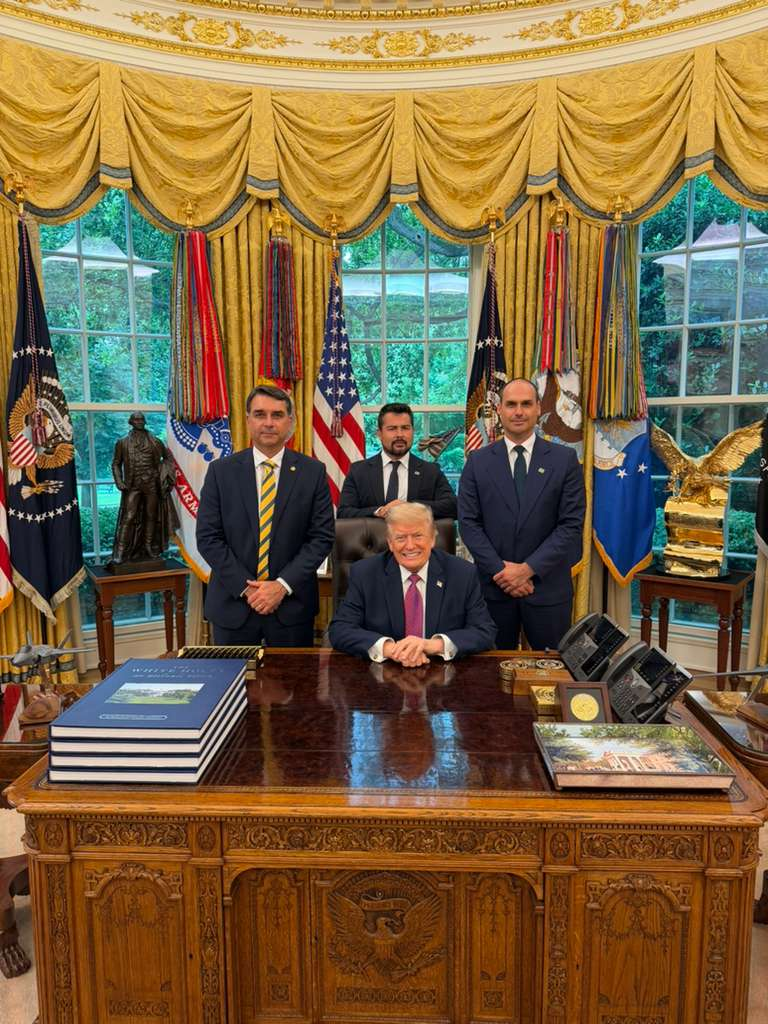
Flávio Bolsonaro, Eduardo Bolsonaro and Paulo Figueredo with Donald Trump
Disclosure
Last week, the US proposed the application of 25% tariffs on Brazilian goods after concluding an investigation that accuses the country of adopting practices that restrict trade with the Americans. The measure is not yet in force.
The survey interviewed 2,004 people aged 16 or over between June 5th and 8th, 2026. The margin of error is 2 percentage points, plus or minus, and the confidence level is 95%. Registration with the Superior Electoral Court (TSE) is BR-07661/2026.
The questionnaire included a block of questions about voters' perception of Brazil's relationship with the United States and the links between pre-candidates Lula (PT) and Flávio Bolsonaro (PL) with American President Donald Trump.
Flávio’s meeting with Trump
50% of those interviewed said they were aware of the meeting between Trump and Flávio Bolsonaro, held at the end of May. Another 50% said they did not know about the meeting.
Next, voters answered questions about the American president's support for the son of former president Jair Bolsonaro (PL).
Now on g1
PCC and CV classified as terrorists
The survey also questioned respondents about Trump's decision to classify the PCC and Red Command as terrorist organizations.
63% said they were already aware of the measure, while 36% said they only found out about the matter during the interview. Another 1% were unable to respond or did not want to speak.
They were then asked whether criminal organizations such as the PCC and Comando Vermelho should be considered terrorist organizations by the Brazilian government.
For 60%, the answer is yes. Another 29% said no. Those who did not know or preferred not to answer totaled 11%.
The survey also asked whether these organizations should be classified as terrorist by the United States government. 45% agree with the measure, while 45% disagree. Those who did not know or preferred not to answer account for 10%.
Respondents answered whether they believe Flávio Bolsonaro influenced Trump in the decision to classify the PCC and Comando Vermelho as terrorist organizations.
47% believe that the parliamentarian had influence on the decision. 37% say he had no participation. Those who did not know or preferred not to answer totaled 16%.
The factions began to be classified as terrorist organizations by the United States government in June. The decision was released by the Trump administration at the end of May.
The announcement was made one day after Flávio Bolsonaro met with the US Secretary of State, Marco Rubio.
Security experts assess that the United States' decision to classify Brazilian factions as terrorist organizations represents a risk to national sovereignty. Proponents of the measure claim that it could open up space to expand international cooperation.
📰 Related Articles

Man shot dead a kilometer from the Pope's route
Observador/https://i.s3.glbimg.com/v1/AUTH_59edd422c0c84a879bd37670ae4f538a/internal_photos/bs/2026/9/i/iSB5T4SB2i8SARuJXB4A/foto-no-tamanho-home-2026-06-10t081435.183.png)
Man dies in accident in southern Bahia
G1 GloboIn AI failure, more than 34 thousand Instagram accounts were hacked
O Globo
Mega-Sena 3016: 11 bets from the interior of PE win prizes; check result
G1 Globo
16 concerts not to be missed at Primavera Sound
Observador