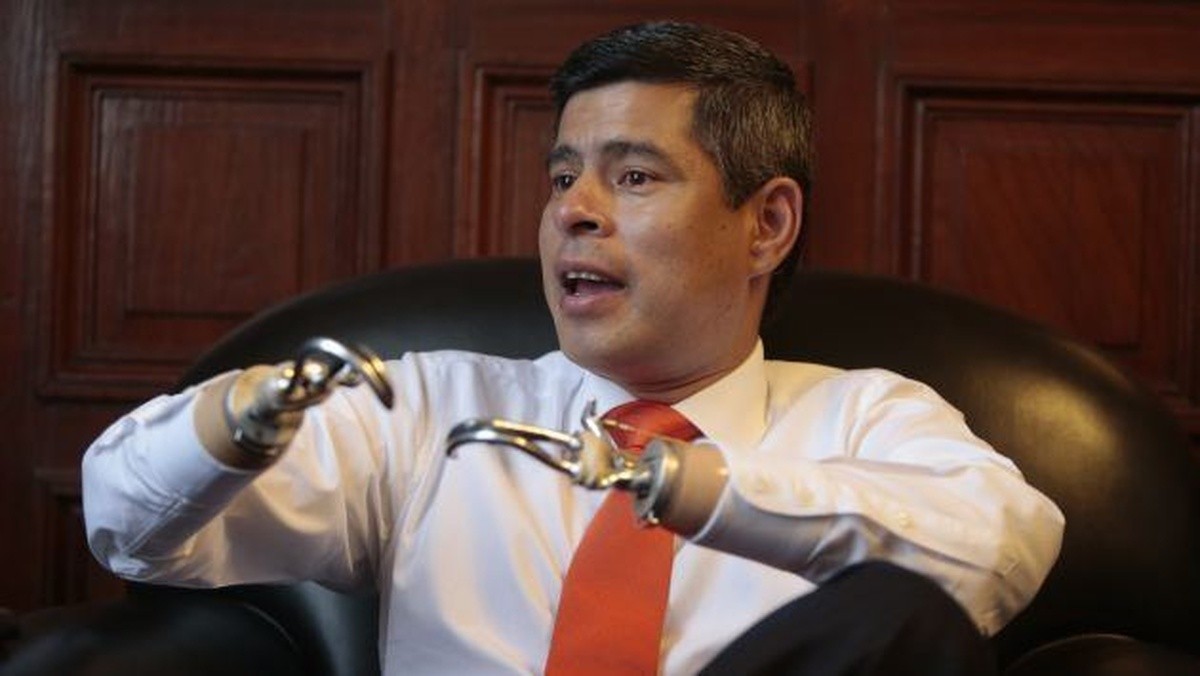
Who is Luis Galarreta, Keiko Fujimori's deputy, who lost his hands as a baby and entered politics with Vargas Llosa
⚡ Quick Summary
Luis Galarreta, Keiko Fujimori's running mate in the elections in Peru.
Luis Galarreta, Keiko Fujimori's running mate in the elections in Peru.
Reproduction/Social Media
The elections in Peru remain fierce in the 2nd round between candidates Roberto Sánchez, from Together for Peru, and Keiko Fujimori, from Força Popular. A figure that has gone viral is that of Luis Galarreta, Fujimori's running mate, who uses a hook-shaped prosthetic instead of his hands.
📱Bookmark g1 on Google and follow the main news of the day
Born in Lima in 1971, Galarreta came into the world with a congenital malformation in his upper limbs. When he was just three months old, doctors recommended amputating his arms.
According to him, his mother had taken a medication during pregnancy that affected fetal development.
"My story is very rich, I wouldn't change anything. During pregnancy, my mother took a medication that affected the development of fetuses. Before my birth, my parents were informed that I could have a malformation and that the medical recommendation was to amputate a part of my body. It must have been a very difficult decision", said the parliamentarian in an interview with journalist Milagros Leiva's YouTube channel.
Now on g1
Galarreta in politics
Before approaching Fujimorism, Galarreta built his political career within the Movement for Freedom, a group led by writer and then presidential candidate Mario Vargas Llosa. His first electoral contest took place in 2001, when he tried for a seat in Congress with the National Unity bloc, without success.
The following year, he was elected councilor of Lima. In 2006, he won his first term as deputy and ended up re-elected in 2011. At the time, he was part of the Christian Popular Party (PPC), a center-right group that kept its distance from the movement led by Keiko Fujimori.
See how the elections are being counted in Peru
The relationship between Galarreta and Fujimorism, however, was not always friendly. In 2011, he harshly criticized the government of Keiko's father, former president Alberto Fujimori, stating that the 1990s had been marked by institutional problems, human rights violations and cases of corruption.
Peruvian presidential candidate Keiko Fujimori, from the Popular Force party, speaks alongside her vice-presidential running mate, Luis Galarreta (left), and senator-elect Miguel Ángel Torres after the polls close in the second round of the presidential election, in Lima, Peru.
Martin Mejia/AP
After leaving the Christian Popular Party citing personal reasons, Galarreta joined Fuerza Popular in 2015, a party led by Keiko Fujimori. The decision represented a political shift and turned him into one of the candidate's main allies.
Already in the new party, he was spokesperson during the 2016 presidential campaign and, the following year, assumed the presidency of the Peruvian Congress. Furthermore, he also began to publicly defend the legacy of the 1990s, stating that Alberto Fujimori's government had mistakes and crimes, but presented positive results in other areas.
Currently, in addition to being part of Keiko Fujimori's presidential ticket, Galarreta holds the position of vice-president of the Andean Parliament.
Luis Fernando Galarreta and Miguel Ángel Torres, from Keiko Fujimori's Força Popular party, speak to journalists on the day of the second round of the presidential election between Fujimori and left-wing candidate Roberto Sánchez, in Lima, Peru.
Alessandro Cinque/Reuters
📰 Related Articles

Water delivery man sexually assaults elderly woman alone at home in MG
G1 Globo
Airbus reveals helicopter capable of flying without a pilot; see how it works
G1 Globo
For the first time, Emirates promotes two UAE pilots to aircraft captains
G1 Globo
Defense says mothers tried to prevent their child from leaving and denies abandonment in case of 'disadoption': 'they never agreed'
G1 Globo'War tax': the mechanism used by factions to raise money in dominated areas
G1 Globo