Bilawal proposes abolishing Kashmir Affairs ministry
⚡ Quick Summary
MUZAFFARABAD: PPP Chairman Bilawal Bhutto-Zardari on Friday pledged greater constitutional empowerment for Azad Jammu and Kashmir (AJK), proposing the abolition of the federal Ministry of Kashmir Affairs, enhanced representation for the region in federal institutions and a consultative process to shape future constitutional reforms.
MUZAFFARABAD: PPP Chairman Bilawal Bhutto-Zardari on Friday pledged greater constitutional empowerment for Azad Jammu and Kashmir (AJK), proposing the abolition of the federal Ministry of Kashmir Affairs, enhanced representation for the region in federal institutions and a consultative process to shape future constitutional reforms.
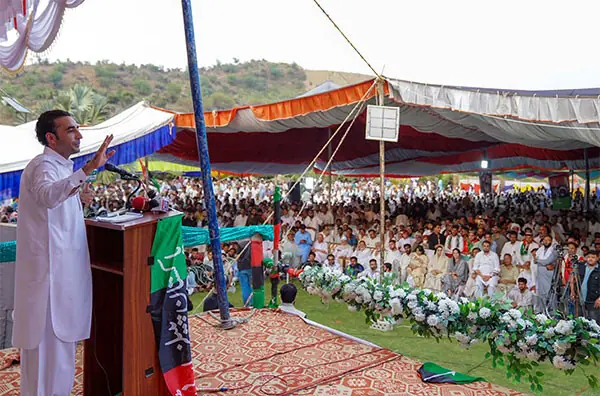
Launching his party’s campaign for the July 27 AJK elections by addressing the first of four planned public meetings in the lakeside town of Dadyal in Mirpur district, Mr Bhutto-Zardari described the polls as the most significant in the region’s history. He said the prevailing situation was a test not only for Kashmir and Pakistan but also for all political parties.
The PPP chairman outlined what he described as his party’s constitutional agenda for AJK and Gilgit-Baltistan (GB), announcing that constitutional conventions would be convened in both regions after the elections to seek stakeholders’ input on future legislative reforms.
He reiterated his party’s position that, while protecting refugee seats, legislation should ensure that only the people of Jammu and Kashmir determine their political future.
PPP chairman launches party’s election campaign from Mirpur
Mr Bhutto-Zardari said the PPP wanted AJK to be granted interim representative status in national forums such as the National Finance Commission (NFC) and the Council of Common Interests (CCI), similar to the observer status secured for Kashmir in the Organisation of Islamic Cooperation (OIC) during Benazir Bhutto’s tenure.
He also called for greater autonomy for AJK, saying there would be no need for the Ministry of Kashmir Affairs if powers were devolved to the elected government. He proposed allowing the AJK government to nominate a representative on foreign affairs who could be part of the federal cabinet to represent Kashmir’s interests.
Calls for dialogue to end unrest
Referring to the ongoing standoff between protesters and the state in AJK, Mr Bhutto-Zardari recalled that he had earlier proposed the formation of a Truth and Reconciliation Commission to address the issues underlying the unrest.
He said protesters had written to him seeking support, and he had suggested that such a commission could provide a way forward if accepted by both sides.
“If both the state and the protesters agree to this proposal, a way forward can be found,” he said, adding that he would ask protesters to call off their agitation once such a commission was constituted, while urging the state to suspend its action until the commission completed its work.
He regretted that neither side had responded to the proposal and questioned what alternative solution remained if both rejected it.
While describing peaceful protest as a fundamental democratic right, Mr Bhutto-Zardari criticised the manner in which the agitation had been conducted, saying road blockades that caused shortages of food, fuel and medicines had only compounded the suffering of ordinary Kashmiris.
At the same time, he criticised the authorities for continuing the suspension of internet services, saying the government was also punishing the public instead of the protesters.
Drawing a parallel with Pakistan’s diplomatic role in regional affairs, he remarked that if Pakistan could help mediate between the United States and Iran and contribute to reopening the Strait of Hormuz, it should also help “reopen Kashmir”.
Referring to recent political controversy, Mr Bhutto-Zardari criticised Defence Minister Khawaja Asif over his reported remarks regarding Kashmiri identity, saying politicians who did not even regard Mirpur, Kotli and Rawalakot as part of Kashmir had no moral right to hold federal office.
He also criticised the prime minister’s adviser on political affairs, Rana Sanaullah, for reportedly claiming that 12 AJK constituencies were “in their pocket”.
Published in Dawn, July 18th, 2026
📰 Related Articles

Pakistan to revise oil prices daily amid renewed West Asia tensions
The Hindu
Egypt's 'Garbage City' recyclers reap gains from Iran war plastic squeeze
Dawn PakistanU.S. and Iran escalate strikes across Mideast
NPR
Ballon d’Or 2026: Mendieta names top two players to win award
Daily Post Nigeria
U.S., Iran escalate strikes across West Asia
The Hindu