


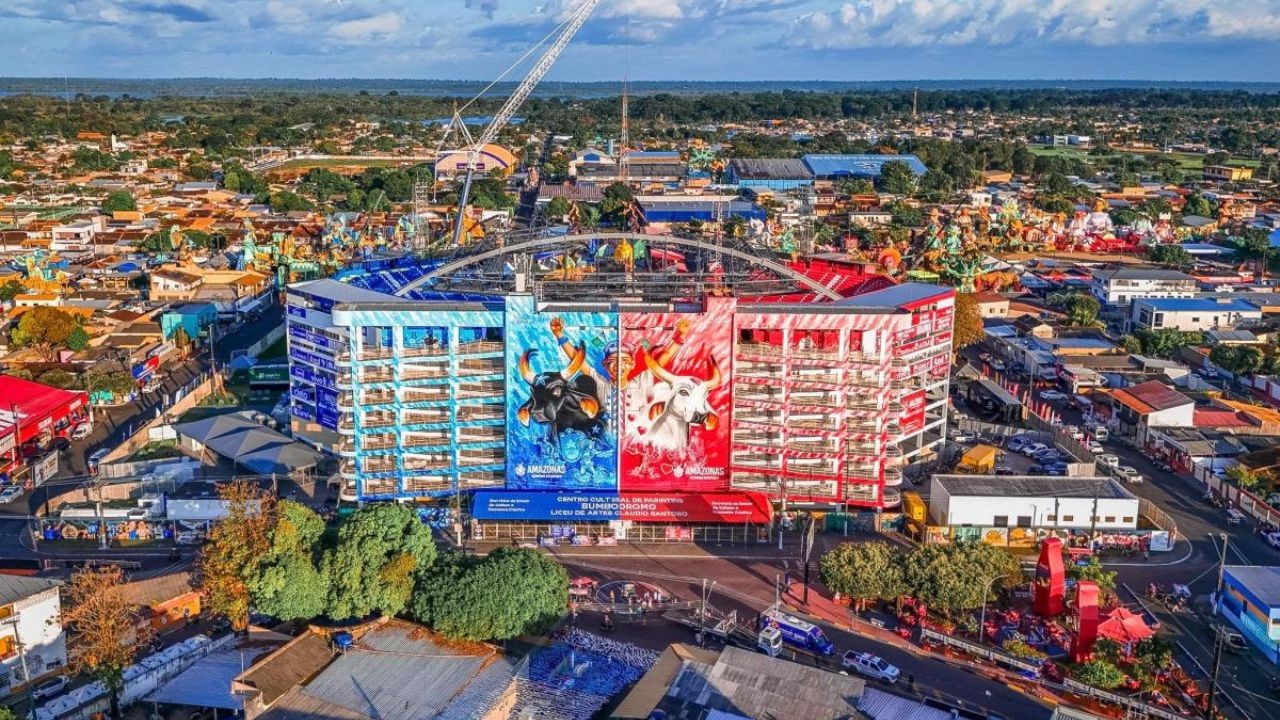
How an island in the middle of the Amazon prepares to receive crowds at an ox festival and giant floats
⚡ Quick Summary
Discover the island of Parintins In the heart of the largest tropical forest on the planet, where the Amazon River dictates the rhythm of time and the greenery seems to have no end, an island of just over 6 thousand square kilometers prepares annually to see, at the end of June, the population of more than 96 thousand inhabitants more than double.
Discover the island of Parintins
In the heart of the largest tropical forest on the planet, where the Amazon River dictates the rhythm of time and the greenery seems to have no end, an island of just over 6 thousand square kilometers prepares annually to see, at the end of June, the population of more than 96 thousand inhabitants more than double. Under the watchful eyes of visitors, cloth oxen and giant allegories bring to life the reason that attracts this crowd to the place: the Parintins Festival.
🔍Considered one of Brazil's greatest cultural heritages, the Parintins Folklore Festival is a popular festival that celebrates Amazonian culture and the centuries-old rivalry between the Caprichoso and Garantido ox-bumbás. In 2026, the traditional dispute on the island located in the interior of Amazonas will take place on the 26th, 27th and 28th of June.
For the 2026 edition, the promise is not just of excitement, but of records. The Amazonas State Tourism Company (Amazonastur) projects the arrival of 120 thousand tourists. This "river" of people, divided between the colors of Boi Caprichoso (blue and white) and Boi Garantido (red and white), is expected to inject more than R$220 million into the local economy, moving everything from restaurants and hotels to street vendors.
"Parintins can't be explained, just feel it. It's a heart-island that pulses to the beat of the music, where the forest is dressed in silk and Amazonian legends come to life in monumental structures that defy gravity under the Amazonian sky", says Parintins resident, Igor Vinícius.
Parintins Island🏝️
Unlike oceanic islands, Parintins is a fluo-lacustrine island. Its geological formation is considered young, dating back to the Quaternary period, which began around 2.5 million years ago.
The island was shaped by the force of the Amazon River, through the accumulation of sediments coming from the Andes Mountains. The current design of the region was defined by the seasonal behavior of floods and ebbs, which isolated the portion of dry land in the midst of the complex of lakes and paranás.
The first inhabitants of the island were the indigenous people of the Tupinambarana and Sateré-Mawé ethnicities. From the 18th century onwards, with the Carmelite missions and the arrival of Portuguese colonizers, the process of miscegenation began in the region.
At the end of the 19th century, the Rubber Cycle in Amazonas attracted a strong wave of migration from people from the Northeast, mainly from Ceará and Maranhão. This group took up residence on the island and merged their traditions, such as bumba meu boi, with local indigenous legends.
Where magic takes shape: the headquarters of Garantido and Caprichoso
Allegories of Caprichos and Guaranteed
Alex Pazuello and Lucas Silva
If the Arena do Bumbódromo de Parintins is the stage for the show, the clubs' warehouses are the true powerhouses of the Amazonian imagination. It is in these industrial-artistic complexes that the festival begins to be produced, months before June, under a regime of absolute dedication and extreme rivalry. Together, the two oxen directly mobilize more than 2,500 workers.
The gigantism is so great that the allegories are built in separate modules in the warehouses. Artists need to calculate down to the millimeter how these parts will fit together just at the time of the show. This entire process takes place under guarded gates and a strict ban on images to prevent engineering secrets or the themes of the allegories from being leaked to the rival.
When the modules finally leave the warehouses and are manually pushed through the streets of Parintins to the Bumbódromo in the traditional and exciting "transfer operation", the silent effort of months ends in tears of pride. Behind each giant creature that comes to life in the arena, there is the callus on the hands and the heart of a worker from the Parintina culture. The monumental allegories of the Parintins Festival draw attention precisely because of their gigantism and engineering complexity, reaching or even exceeding 25 meters in height, the equivalent of an eight-story building, and extending over 60 meters in width across the arena.
The geography of the Island divides not only the fans, but also the creation centers of each bumbá:
❤️ Guaranteed City
Located in the traditional neighborhood of Baixa do São José, a historic stronghold and heart of the red and white Boi, Cidade Garantido is the complex where everything begins to come to life. There, work is driven by pure communal passion, with artists and workers working surrounded by the warmth of the community.
The workers at the Garantido shed focus intensely on the expressiveness of their sculptures and the engineering of movements that bring to life the myths and legends of the forest, transforming the shed into a hotbed of popular inventiveness.
⭐ Galpão das Artes Mestre Jair Mendes
Boi Caprichoso centralizes its operations at Galpão das Artes Mestre Jair Mendes, a tribute to the artist who transformed the Parintins Festival by giving life and movement to the allegories, leaving an eternal legacy that shaped the visual identity and genius of Boi Caprichoso. Bumbá stands out for its almost factory-like organization and cutting-edge infrastructure.
Famous for its impeccable finish, visual refinement and pioneering use of new technologies and lightweight materials, the floats produced at Galpão do Caprichoso usually reach impressive levels of gigantism and minute details in stones and fabrics.
The hospitality challenge: from hotel beds to luxury homes
Parintins Festival 2026: with hotels full, house rentals reach R$247 thousand
Accommodating a crowd of this size on a river island requires engineering and detachment. The search for accommodation transformed the quiet city into one of the most valued square meters in the country during this period. With the traditional hotel chain operating at maximum capacity for months, residents have transformed their homes into temporary inns.
According to a survey by g1, real estate appreciation for the season reaches impressive levels. In valued areas of the island, property rentals for the festival period can reach a significant R$247,000.
Those who haven't secured a place in hotels resort to this alternative market or the traditional boats and hotel boats, which dock at the city's port, transforming the riverfront into a vibrant extension of the party itself.
READ ALSO:
She roots for Garantido, he for Caprichoso: couple makes the cattle fight part of their love story
Parintins Festival 2026: composers reveal the secrets behind the crowd's 'hit' songs
Protective wall on land and rivers: the security plan
Faced with such a significant migratory flow, the State Secretariat for Public Security (SSP-AM) structured an integrated plan to erect a true protective shield over Tupinambarana Island during the 59th Folklore Festival.
A task force made up of more than 1,100 Security Force employees will be mobilized, bringing together military police (PMAM), civilians (PC-AM), scientific experts (DPTC) and the Fire Department (CBMAM), supported by 90 land vehicles and a fleet of armored boats. The headcount represents a 10% increase in the exclusive headcount compared to the 2025 edition.
As the waters of the Amazon River serve as the main access route to the party, the river policing and rescue teams will closely patrol the vessels, intensifying inspection on the main traffic routes to protect the lives of riverside dwellers and tourists.
Reception logistics: urban infrastructure actions
Touristdrome in Parintins, in the interior of Amazonas
Lucas Silva/Amazonastur
In addition to the defense apparatus, Amazonastur and the State Government keep the reception gear operating at full steam. The plan extends to deep interventions in the city's urban infrastructure:
Tourism Station: Official physical point for delivering informative passports and geographical and cultural guidance to visitors.
Amazonas To Go: Digital application that puts real-time mapping of inns, restaurants and reliable transport options in the palm of your hand.
Gastronomic Square: Space aimed at strengthening local micro-entrepreneurs, serving traditional cuisine with fish from the basin (tambaqui and tucunaré) and tucumã delicacies.
Ordinance of Tricycle Riders: Standardization and delivery of official uniforms for the class that drives local tourism, bringing fare security and visual identification to passengers.
X-Ray Infographic of the Parintins Festival
Photo: g1/art
Bumbódromo de Parintins, stage of the folk festival
Disclosure/City Hall of Parintins
📰 Related Articles
Woman reacts to robbery and tries to prevent criminals from escaping on Orla Bardot, in Búzios; VIDEO
G1 Globo
VIDEO: Luan Santana sees a poster with a fan's request and invites the pregnant woman to the stage for a revelation tea during a show in Paraná
G1 Globo
Médio Tejo has a plan for municipalities vulnerable to fires
Observador
Until what age should children sleep in their parents' bed?
Observador
Drunk driver arrested after running over street cleaner who worked in DF
G1 Globo