PTI rules out CoD-style Charter of Economy
⚡ Quick Summary
• Khosa questions effectiveness of 2006 charter, claiming its commitments were never honoured ISLAMABAD: As Prime Minister Shehbaz Sharif offered dialogue to the opposition and suggested that all political parties work towards a “Charter of Economy”, the PTI on Sunday made it clear that the premier should not expect a PPP-PML-N-style CoD from the party.
• Khosa questions effectiveness of 2006 charter, claiming its commitments were never honoured
ISLAMABAD: As Prime Minister Shehbaz Sharif offered dialogue to the opposition and suggested that all political parties work towards a “Charter of Economy”, the PTI on Sunday made it clear that the premier should not expect a PPP-PML-N-style CoD from the party.
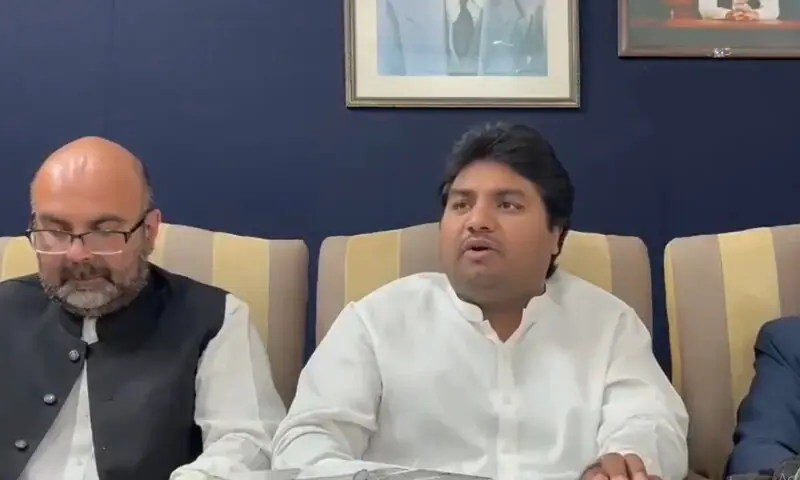
Party leaders Sardar Latif Khosa, Taimur Khan Jhagra, Mobeen Arif Jutt and Rana Atif were speaking at a press conference in Islamabad.
Mr Khosa questioned the outcome of the earlier CoD signed by Benazir Bhutto and Nawaz Sharif in 2006, stating that not a single commitment under the accord had been honoured. He claimed that subsequent governments had acted contrary to its spirit by weakening democratic norms and constitutional supremacy, eroding judicial independence, manipulating electoral processes, restricting political freedoms and freedom of expression, shrinking political space, and undermining the overall democratic framework.
He further said the PML-N formed the government despite securing only 17 seats, while PTI was denied power despite winning more than 180 seats in the general elections.
The PTI leader maintained that party workers and leaders had been subjected to political victimisation, with hundreds of cases registered against Imran Khan, his wife and associates, including Dr Yasmin Rashid, a cancer survivor.
He expressed concern that the budget would not only deepen the suffering of the masses but also negatively affect the national economy. He questioned how the government intended to achieve its revenue targets after failing to meet earlier benchmarks, warning that additional taxation would further burden existing taxpayers and potentially push millions of lower- and middle-income families below the poverty line.
Speaking on the occasion, Mr Jhagra criticised the government for increasing the petroleum levy to as much as Rs100 per litre, arguing that the move would have a cascading impact across all segments of society.
He said the “elephant in the room” was the ever-rising cost of running the state. If the government was serious about putting Pakistan on the path to prosperity, he argued, it would need to demonstrate the courage to slash extravagant expenditures.
Rejecting the government’s claims of economic recovery, he said exports had declined by six per cent and investment by 26.5pc, while most economic targets had been missed across key sectors.
Speaking on the occasion, Mr Jutt said the government had failed to present a clear strategy for broadening the tax base or bringing new taxpayers into the net. He noted that the ruling coalition was presenting its fifth budget, yet had not delivered meaningful relief to the public over the past five years.
Mr Atif questioned the government’s claims of economic stabilisation, arguing that the ruling coalition had imposed unprecedented taxes over the past five years while failing to implement meaningful structural reforms.
Meanwhile, former National Assembly speaker Asad Qaiser said the government had “handed over the economy to the IMF”, leaving farmers, industrialists and other segments of society in distress.
He said PTI had been denied a level playing field in the Gilgit-Baltistan elections.
Published in Dawn, June 15th, 2026
📰 Related Articles
Anger as Nigeria loses 7 military commanders to terrorism, banditry
Daily Post NigeriaFoxconn and Schneider plan AI factories for next-gen data centers
Stock Titan
The new Noida International Airport is graced with Paresh Maity’s paintings
The HinduRussian attack sets fire to religious site in Kyiv, kills 5 in Kharkiv
NPR
Sudip Bandyopadhyay bets on pharma, metals and select cyclicals as geopolitical risks ease
Economic Times IN