NOAA confirms arrival of El Niño; The question now is whether the phenomenon will have record strength
⚡ Quick Summary
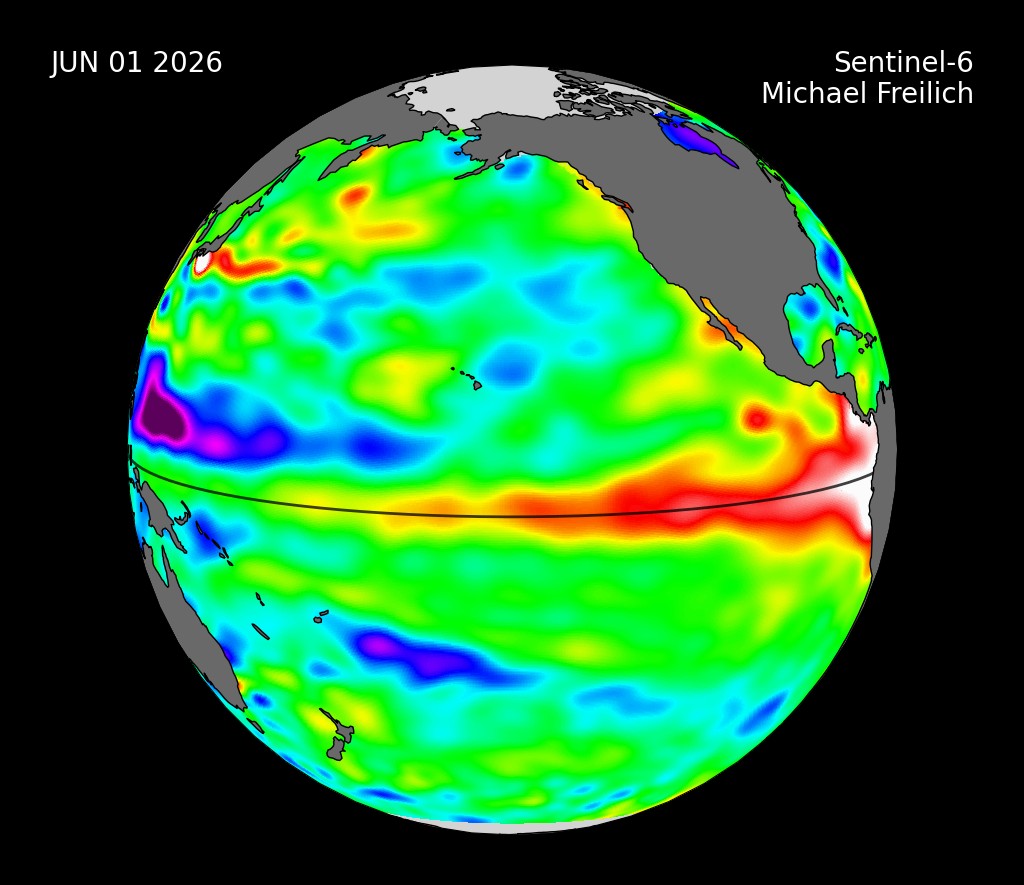
Satellite images show variations in sea level in June 2026; areas in red indicating higher waters in the equatorial Pacific, a typical sign associated with the development of El Niño.
Satellite images show variations in sea level in June 2026; areas in red indicating higher waters in the equatorial Pacific, a typical sign associated with the development of El Niño.
Sentinel-6 Michael Freilich/NASA/NOAA
The United States Oceanic and Atmospheric Administration (NOAA) confirmed this Thursday (11) the formation of El Niño, a natural climate phenomenon that occurs when the surface waters of the Equatorial Pacific Ocean become warmer than normal.
Confirmation was already expected by meteorologists, after months of gradual warming in the Pacific and projections indicating a high probability of the phenomenon developing in the first half of 2026.
🌊 UNDERSTAND: El Niño and La Niña are two phases of the same climate phenomenon, called ENSO (El Niño-Southern Oscillation). El Niño is characterized by warming greater than or equal to 0.5°C of the waters of the equatorial Pacific Ocean.
The phenomenon occurs frequently every two to seven years, lasts an average of twelve months and has a direct impact on the increase in global temperatures. La Niña is the opposite: a cooling of these same waters, with equally significant effects, but in the opposite direction (understand more BELOW).
In Brazil, the effects vary depending on the region. Historically, El Niño tends to increase rainfall in the South, which can increase the risk of storms and floods.
In the North and part of the Northeast, the phenomenon tends to reduce rainfall and can worsen periods of drought.
In the Southeast and Midwest, impacts may be more irregular, with more frequent heat, poorly distributed showers and changes in the behavior of cold fronts.
EVERYTHING YOU NEED TO KNOW ABOUT EL NIÑO:
When was the last 'super' El Niño? Understand why the interval between extreme events has been shortening
Buoys, underwater robots and satellites: how scientists measure the ocean to detect El Niño
El Niño 2026: what it is, why scientists are on alert and how it could affect your life
Projection by the US agency shows that the chance of El Niño increases throughout 2026; intensity remains undefined.
NOAA
The arrival of El Niño is also worrying because the planet is already hotter due to climate change.
The phenomenon alone does not cause global warming. It is a natural variation of the climate system. But when it occurs in an already warming world, it can reinforce extremes of heat, drought and intense rain.
This is why scientists are following the evolution of this event so closely.
A strong El Niño could affect agriculture, water reservoirs, energy generation, the occurrence of fires and even food prices in some regions.
It is not yet possible to say, however, whether the phenomenon confirmed now will be a “super El Niño”. The term is not an official scientific category, but it is often used to describe very intense events, such as those recorded in 1982-83, 1997-98 and 2015-16.
See the videos that are trending on g1
The strength of El Niño depends on how much the Equatorial Pacific will warm in the coming months and, mainly, on how the atmosphere will respond to this warming. For the phenomenon to gain intensity, it is not enough for the ocean to become warmer: the ocean-atmosphere system must begin to act in a coupled and persistent way.
Since 2006, a sequence of El Niño episodes has increasingly changed the planet's climate, which is now warmer than in the past.
Even when considered weak or moderate, these events happen in a warming world and end up increasing the risk of extremes, such as droughts, floods and heat waves. See:
2006–2007: Weak to moderate El Niño.
2009–2010: Moderate El Niño.
2014–2016: Very strong El Niño, linked to record heat and more frequent extremes.
2018–2019: Weak to moderate El Niño, shorter and with more limited impacts.
2023–2024: Strong El Niño, one of the most intense on record, associated with new heat records. 🌎 What El Niño is — and why it matters so much
El Niño is an unusual warming of the waters of the Pacific Ocean near the Equator.
It is part of a natural climate cycle that alternates hot (El Niño), cold (La Niña) and neutral phases — with impacts in various regions of the planet.
This warming changes the circulation of the atmosphere and alters the pattern of rainfall and temperatures in different parts of the world.
In Brazil, the effects tend to be uneven: the South tends to have more rain, while areas of the North and Northeast may experience drier periods.
The phenomenon also influences global temperature. In years of more intense El Niño, the planet tends to experience above-average heat, adding to global warming.
The intensity varies from one event to another, as do the impacts. And, with the planet already hotter, even moderate episodes can have stronger effects than in the past.
For the first time, the world records a day with a global average temperature 2°C above the pre-industrial era
Conditions generated by El Niño can facilitate fires and impact agricultural production.
Michael Dantas/AFP via DW
🌧️ Possible impacts in Brazil
Historically, El Niño changes the rainfall and temperature pattern in the country and causes:
increased rainfall in the South, with a greater risk of extreme events;
reduction of rainfall in the North and parts of the Northeast;
more irregularity in precipitation in the Southeast and Center-West;
higher frequency of hot flashes.
According to experts, one of the main expected effects is the increase in prolonged periods of heat, especially in spring and summer.
Even with the alternation between La Niña, neutrality and El Niño, scientists highlight that global warming remains the main factor behind climate change.
With the oceans already warmer than the historical average, the expectation is that the coming months will continue to record high temperatures in several regions of the planet.
El Niño and La Niña
Art g1/Luisa Rivas
READ ALSO:
Understand how explosions turned 'day into night' in Iran and put the city under acid rain alert
Extreme heat can put athletes at risk at major sporting events, study warns
Hidden side of the jackfruit tree: invasive tree impoverishes Atlantic Forest floor and affects frogs
Shopping guide: 40 options to cool off in the heat
📰 Related Articles
House is destroyed after fire from burning in a lot spreads and hits property in Araguari
G1 Globo
4 reasons why it is difficult to maintain a ceasefire in Iran
BBC Brasil
Sole survivor of plane crash in Marília is discharged from hospital
G1 Globo
World Cup 2026: Brazilian Arena in SP will broadcast games and shows; Ivete and Péricles inaugurate the space, see schedule
G1 Globo
Senate Committee approves new salary floor for doctors and dentists
Agência Brasil