


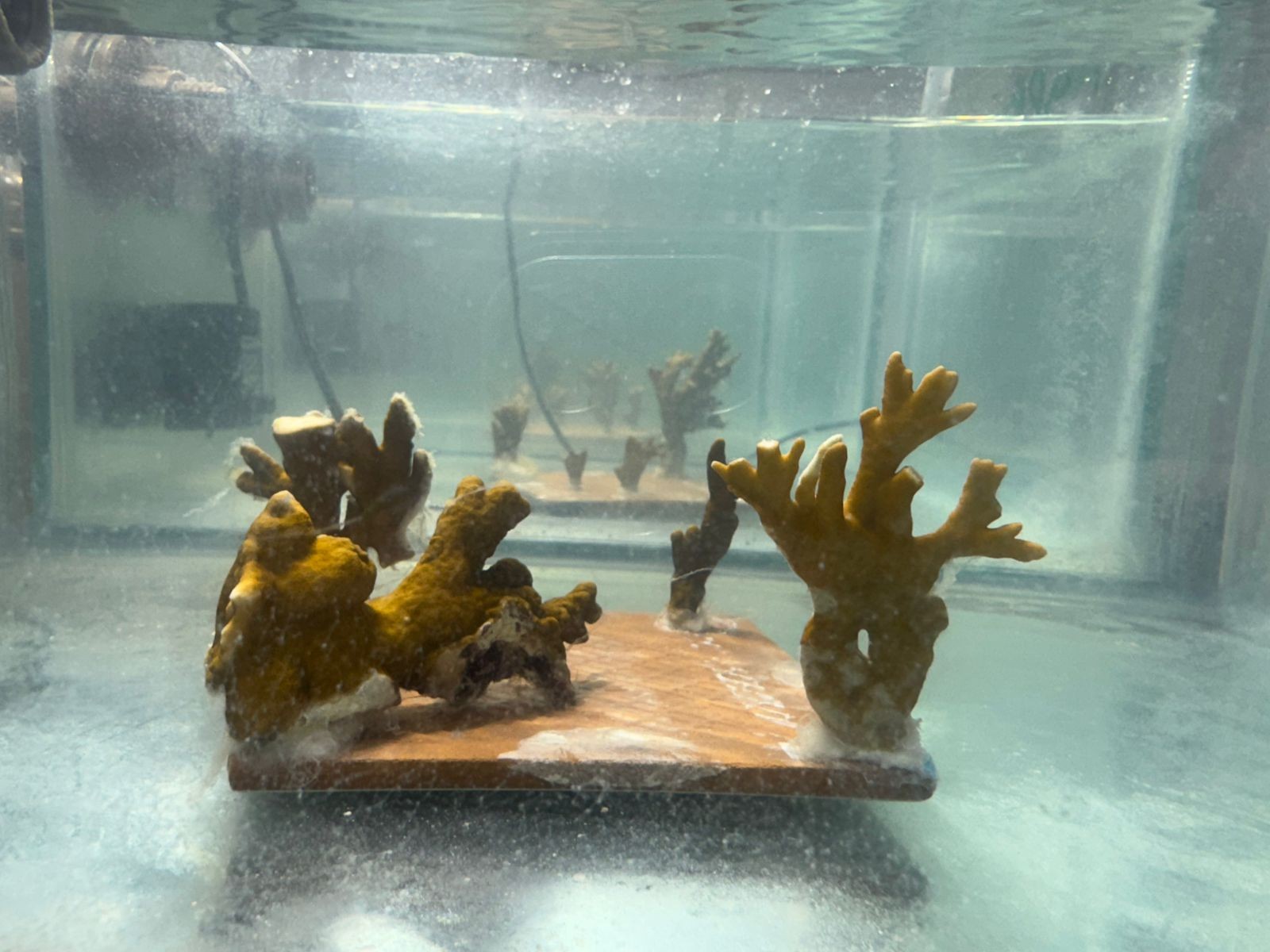
'Coral nursery': scientists test unprecedented experiment to recover reefs affected by the climate crisis
⚡ Quick Summary
Research tests treatment to protect corals from rising sea temperatures Known as the "tropical forests of the ocean", coral reefs are among the organisms most impacted by climate change, which causes sea temperatures to rise.
Research tests treatment to protect corals from rising sea temperatures
Known as the "tropical forests of the ocean", coral reefs are among the organisms most impacted by climate change, which causes sea temperatures to rise. In an attempt to reverse this scenario, a group of researchers created a "nursery" with 24 aquariums that store animal fragments (see video above).
The experiment is carried out by scientists from the Recifal Conservation Project (PCR), which monitors the Costa dos Corais Environmental Protection Area (APA), located between the coasts of Pernambuco and Alagoas. According to the institute, around 80% of the corals that lived there have already died. According to the institution, this is the first study of its kind carried out in the Northeast.
✅ Receive g1 PE news on WhatsApp
Formed by colonies of small marine animals called polyps, coral reefs are home to rich biodiversity and play a fundamental role for marine life (learn more below).
To g1, the PCR coordinator, Pedro Pereira, said that the tests are initially being carried out with the species known as "fire coral" and, later, should be expanded to other species. The idea, according to him, is to find strategies to make corals more resistant to adverse weather conditions and enable the restoration of reefs on the Brazilian coast.
"It's a scientific experiment because we are simulating the natural environment, but we are controlling the conditions to understand, for example, at what temperature the coral will turn white, at what temperature the coral will die, and we are using a probiotic, a substance that we are putting in the corals to try to increase their resistance to the change in temperature. So, what we do is try to control the condition and feed [the coral] with this probiotic to see if it will become more resistant to the change in temperature," he said.
The aquariums are distributed in a room where scientists simulate conditions of the marine environment to test how the use of probiotics can help the health and recovery of these species in the face of rising ocean temperatures.
According to the researcher, who has been following coral reefs for more than a decade, coral care is meticulous and includes strict temperature control, daily salinity checks and constant monitoring of the health of the polyps.
The research is in its first year of activity. The team is made up of seven professionals and has the collaboration of the Federal University of Rio de Janeiro (UFRJ) and an institution in Saudi Arabia.
"This type of research has already been done in other places, in Australia, it has already been done in the Caribbean, but it is the first research to be done in the Northeast of Brazil, testing how the corals here will react to an experiment with probiotics", he informed.
Also according to Pedro Pereira, the next steps of the research will be to evaluate the behavior of corals under treatment and, if the results are positive, take the strategy to reefs in a natural environment.
"Behave, test the results, and then the second step is to do this in nature. It is to be able to put this in the corals that are in nature. At the end of the year and the beginning of next year, there will be very hot periods. [...] And then we want to try to test this to ensure that we don't have such a large death of corals in the natural environment", he said.
research tests treatment to protect corals from rising sea temperatures
Reproduction/WhatsApp
Coral death
According to the researcher, a large part of marine biodiversity depends on coral reefs. Therefore, when these organisms go through the bleaching process caused by increased water temperatures, the impacts can affect fish, crustaceans and other species that depend on this habitat to survive. "The coral bleaches when it is being affected by temperature, so its first step is to turn white. When it is white, it is not necessarily dead, it is just white. And then, if it stays white longer, for a long time, it ends up dying. And when it dies, it doesn't come back to life anymore, the coral is unable to regenerate. And we lost the coral, we lose, as I said, the ecosystem that is being formed there in that environment", he said.
According to the scientist, corals are key organisms for the balance of marine ecosystems. According to him, the death of these species can generate environmental, economic and social impacts, directly affecting activities such as tourism and artisanal fishing.
"Corals also have great economic and social importance because they have great tourism potential. Our beaches here in Pernambuco, Alagoas, are fundamental for tourism based on coral reefs. (...) And social importance, because coral reefs are super important for fishing, for the subsistence of local communities that survive there from fishing. So the loss of corals compromises the entire health of the ecosystem and also the economy", he said.
Another point of concern about the death of corals is the time it takes for this organism to develop. As the formation of these structures occurs over thousands of years, the loss currently recorded may take generations to be reversed.
"A coral reef is formed in millions of years, so the death of corals is also a problem for this reason, because coral is an organism that takes a long time to grow. What we are seeing now, we are seeing the past, we are seeing corals that took many years to grow, so the coral dies now, you can wait several generations for it to be big again", he said.
VIDEOS: most seen in Pernambuco in the last 7 days
📰 Related Articles
Rare feline puppies are rescued and returned to their mother in a forest area in the south of Roraima
G1 Globo
Video with meeting between former chief of investigators and accused of planning prosecutor's death was recorded at the businessman's request
G1 GloboEducation workers protest against layoffs and call for reforms in schools in Parauapebas
G1 Globo
Dias Toffoli takes office as effective minister of the TSE
CNN Brasil
Apple Introduces New Smart Features for 2027; look
CNN Brasil