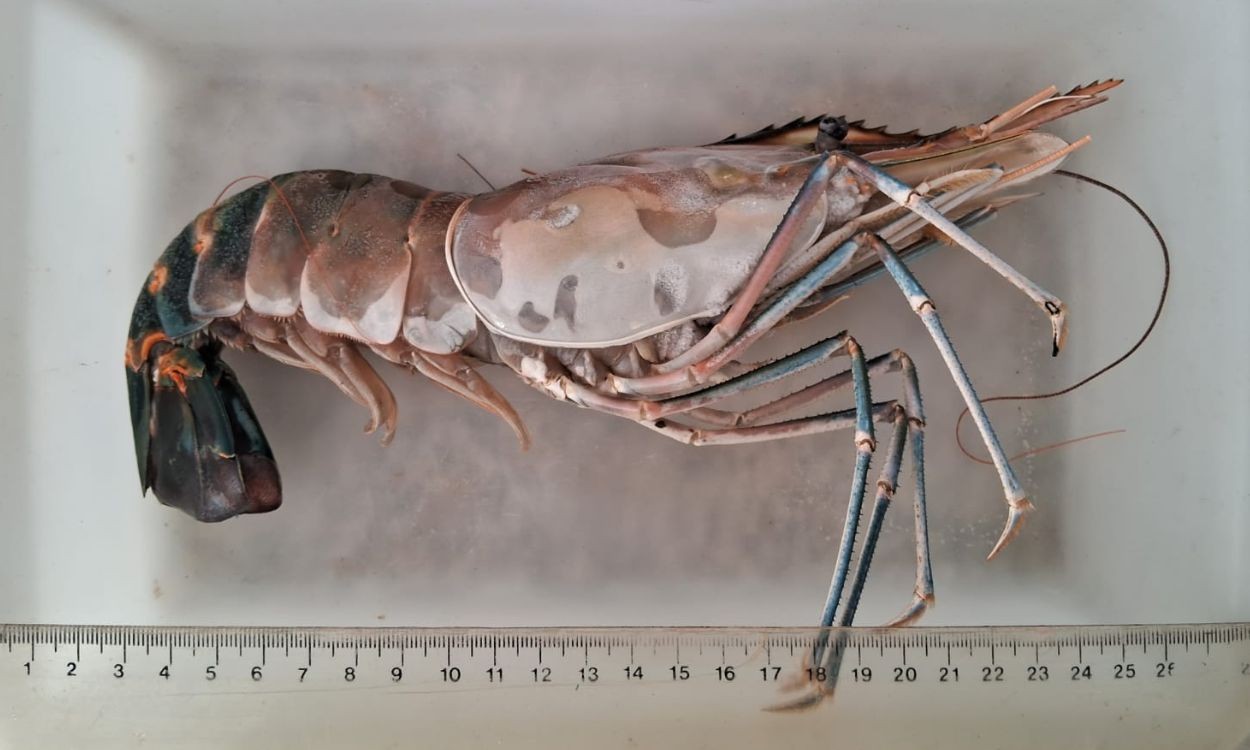
Giant Asian shrimp invades protected areas in Brazil
⚡ Quick Summary
Giant Asian shrimp invades protected areas in Brazil Collaborative work with fishermen from the Iguape-Cananéia-Ilha Comprida Estuarine-Lagunar Complex, on the South Coast of São Paulo, revealed the presence of an exotic species in the region.
Giant Asian shrimp invades protected areas in Brazil
Collaborative work with fishermen from the Iguape-Cananéia-Ilha Comprida Estuarine-Lagunar Complex, on the South Coast of São Paulo, revealed the presence of an exotic species in the region. Between 2015 and 2025, researchers recorded several captures of the Malaysian giant shrimp (Macrobrachium rosenbergii), originating in Asia.
📱 Receive content from Terra da Gente also on WhatsApp
During the period, around 25 artisanal fishermen received training to identify the crustacean and record incidental catches during their fishing activities.
Whenever they found a specimen, the team informed the researchers of the capture location and provided the animal for analysis. In ten years of monitoring, the study recorded 90 specimens of the species in the estuarine complex.
The mere presence of the species, however, is not the biggest problem. The researchers discovered females with eggs in the locations studied, which indicates that the shrimp is reproducing and colonizing protected Brazilian areas where it does not originally belong.
Invader on the coast: Malaysian giant shrimp establishes itself in a preserved area
Edison Barbieri
In the cities of Cananéia (SP) and Iguape (SP), the team found five females in these conditions, evidence considered fundamental that the populations are already self-sustainable.
"The simple capture of individuals does not prove that the population is established, as they could just be organisms coming from recent escapes from aquaculture (breeding). However, the presence of females carrying eggs demonstrates that the reproductive cycle is occurring at the site", explains the study's main author, Edison Barbieri, director of the Regional Research Center for the Southern Coast of the Fisheries Institute.
"Giant shrimp" threat
Invader on the coast: Malaysian giant shrimp establishes itself in a preserved area
jujuwild/iNaturalist
Upon establishing itself in the region, the Malaysian giant shrimp begins to compete with native species for food, shelter and space. This dynamic changes the structure of the ecosystem's food chains. Furthermore, there is a risk that the invading animal harbors viruses and bacteria.
A great example is the White Spot Syndrome virus, a disease that affects shrimp around the world.
How the invader arrived in Brazil
Scientists warn of invasion of Asian giant shrimp on the coast of São Paulo
Edison Barbieri
Native to Southeast Asia, the Malaysian giant shrimp was introduced to Brazil in 1977 for testing in shrimp farming, which is the cultivation of shrimp in captivity. Since then, successive escapes from nurseries have allowed the species to disperse to different river basins and estuaries — transitional coastal ecosystems — in the country.
According to Barbieri, farming continues to be the animal's main entry point into natural ecosystems.
“The commercial cultivation of shrimp in different Brazilian regions generates permanent risks of individuals escaping into rivers, lagoons and estuaries”, says the researcher.
Despite this, the escapes alone do not explain the success of the invasion. The crustacean has biological characteristics that favor rapid adaptation to new environments, supporting diverse environmental conditions.
The invasive shrimp tolerates both fresh and brackish water, has territorial behavior and presents opportunistic feeding. The animal is also notable for its rapid growth and sexual maturation, in addition to producing a large number of eggs.
Presence in protected areas triggers alert
Malaysian giant shrimp establishes itself in preserved area
Syrist/Wikimedia Commons
In addition to the records in the Cananéia region, the study identified occurrences of the Malaysian giant shrimp in other protected areas along the Brazilian coast. For Barbieri, the scenario on the South Coast of São Paulo is of extreme concern, as the estuarine complex is considered one of the most important coastal environments in the country for biodiversity conservation.
See also:
Race for mullet: why did Brazil suspend fishing for the most sought after fish of the winter?
Águas de Lindóia: 15,000-year-old sources combine stories of healing and spatial mystery
Largest venomous snake in the Americas gives birth to 6 babies in Butantan
The site is home to a wide variety of fish, crustaceans and birds, functioning as a true natural nursery for several species of ecological and economic importance.
As with other biological invasions, complete eradication of the Malaysian giant shrimp once established is considered very difficult. For this reason, the scientist argues that monitoring and prevention must be continuous.
"After the establishment of an invasive species, its complete eradication is generally very difficult and, in many cases, unfeasible. Therefore, the most effective strategy remains prevention", he highlights.
Malaysian giant prawn is used in cooking
svetlanarussia/iNaturalist
To reduce the impact and control the problem, the study recommends a series of measures:
Permanent monitoring of exotic species;
Strengthening environmental surveillance;
Continuous assessment of interactions between invasive and native species;
Genetic and epidemiological studies;
Expansion of records in invasive species databases;
Development of specific public policies for prevention and control.
*Under the supervision of Rodrigo Peronti.
VIDEOS: Terra da Gente Highlights
See more content about nature on Terra da Gente
🗞️ 1 sources covered this story

📰 Related Articles
/i.s3.glbimg.com/v1/AUTH_59edd422c0c84a879bd37670ae4f538a/internal_photos/bs/2021/p/U/NQo77ZQaOKcQ5j2QFVeQ/img-facebook.jpg)
WWDC 2026: Apple launches iOS 27 and more news now
G1 Globo
Between beaches, trails and parks, Penha designs a new phase of tourism
G1 Globo
Find out who the five people died in a BMW accident in MG
G1 Globo
Who received the Butantan dengue vaccine that was suspended by the government
CNN Brasil
iOS 27 is announced by Apple with more than 250 new functions
CNN Brasil